

Key Takeaways
- The profit in flipping is almost always in the purchase — buying right is the single most critical factor, in any market.
- Inventory levels are the leading indicator of price direction. Tracking them helps you understand which way the market is heading before prices confirm it.
- Execution breakdown — delays, budget overruns, poor project management — kills deals in every market, not just downturns.
- Overbuilding and over-finishing are common rookie mistakes. Build for the neighborhood, not for your personal taste.
- Successful flippers stay disciplined in hot markets and selective (not inactive) in slow ones. They adapt their strategy but never their principles.
- Backtesting your profit is essential. Separate what you earned from what the market handed you.
- Liquidity matters. Stick to mid-market, high-demand properties with a large buyer pool, especially when starting out.
- Private lenders like Calvert evaluate three things: Is the deal profitable? Can you execute? Do you have the capital?
- Flipping is active income, not passive. If you are not willing to be hands-on — especially early on — reconsider the strategy.
Introduction
House flipping in Calgary gets a lot of attention — and for good reason. Done well, it can generate significant profit in a relatively short timeline. Done carelessly, it can wipe out months of work and leave you worse off than when you started.
We recently had the opportunity to sit down with Jesse Bobrowski, Vice President of Business Development at Calvert Home Mortgage Investment Corporation, to get a lender’s perspective on what actually makes flippers succeed — and where they tend to fall apart. With Calvert having operated for 50 years and having deployed approximately $300 million to real estate investors in a single fiscal year across roughly 800 properties (the majority in Calgary), Jesse and his team have seen more flips than just about anyone in this market. Their data is real, their track record is long, and their insights are worth paying attention to.
What follows is a breakdown of everything Jesse covered — market cycles, common failure points, what successful investors do differently, and how private lending actually works for flippers.
Understanding the Calgary Market Cycle
Jesse emphasized that real estate is cyclical, and Calgary in particular has historically moved through cycles roughly every six to seven years. Understanding where you are in that cycle is foundational to making sound investment decisions.
The Key Indicator: Inventory
According to Jesse, inventory is the leading indicator for price direction — not the other way around.
- Low inventory (under 3 months): Supply is constrained, prices trend upward. Seller psychology is bullish.
- Moderate inventory (3–4 months): A balanced or transitioning market.
- High inventory (over 4 months): Supply is building, prices soften. Buyer demand weakens and days on market increase.
A simple way to calculate inventory in a given neighborhood: divide the number of active listings by the number of sales in the last month. Three listings sold last month with nine currently active means you have three months of inventory. Jesse recommends working with a larger sample size when possible — ideally 30 sales against 90 listings — for a more reliable read.
>
Where Calgary Sits Right Now
Jesse noted that following several years of unusually strong market conditions since COVID — higher than normal transaction volume, tight inventory, and rising values — the market has softened somewhat over the past several months. Inventory is up and values are flat to declining in some segments, particularly condos.
That said, the picture is highly localized. Single-family homes in the $600,000 to $900,000 range remain in demand, with limited new supply in established neighborhoods. Townhouses are still reasonably active. Condos, on the other hand, are oversupplied, with more product coming online. Jesse’s direct advice for flippers: stay away from the condo market for now. For long-term holds, the calculus is different — but for a flip, the risk-reward is not favorable.
Where Flippers Get Caught: The Most Common Failure Points
Jesse made clear that investors run into trouble in every type of market — hot, neutral, and down. The failure modes just look a little different depending on the conditions.
Overpaying
In a rising market, FOMO is real. Buyers get caught up in competition and pay more than the numbers support. Jesse’s take: the profit is almost always in the purchase. If you overpay, you have already compressed your margin before you have even picked up a hammer. That is hard to recover from.
“Where your profit is nine times out of ten is in the buy. It’s buying right.” — Jesse Bobrowski
Budget Overruns
This one kills deals in every market. Jesse noted that overruns are not just a financial problem — they usually create delays, which compound the issue. Every additional week your property sits carries costs: financing, property tax, utilities, snow removal. On a typical flip, those carrying costs add up fast.
Overestimating the After Repair Value (ARV)
The After Repair Value (ARV) is what the property is expected to be worth once renovations are complete. Getting this number wrong is one of the most damaging mistakes a flipper can make, because it forms the basis of all your profit calculations. Jesse pointed out that the average appraiser might only evaluate a handful of post-renovation properties per year. Calvert, by contrast, does hundreds of ARV assessments annually and follows up on every project — giving them a feedback loop that most appraisers simply do not have.
Poor Timelines and Project Management
Time is money in flipping — Jesse repeated this several times, and it is worth taking seriously. Delays can come from poor project management, supply chain issues, or simply missing on your initial timeline assumptions. When the market is moving down, sitting on a property for an extra two months does not just cost you carrying costs — it can also mean the property is worth less when you finally list it.
Jesse’s recommendation: plan your timeline on a realistic-to-pessimistic basis, not an optimistic one. If you think you can finish in two months, plan for three. If you think you can do it for $40,000, budget $50,000. The deals that succeed are the ones where the numbers still work under conservative assumptions.
Overbuilding
Flippers — especially newer ones — sometimes over-finish a property. They install features they personally love (steam showers, premium granite, designer fixtures) in houses that do not support that level of finish. Buyers in the mid-market cannot tell the difference between a $200-per-square-foot kitchen and a $1,000-per-square-foot kitchen, and they are not paying for it. Jesse’s advice: build for the neighborhood. Use builders-grade materials that are clean, functional, and broad in appeal. Brushed nickel over rose gold. A functional Moen faucet over an Italian one. Vanilla over anything unique.
Taking on Too Many Projects at Once
Jesse has seen skilled, successful flippers who executed one project at a time with precision completely fall apart when they tried to scale to multiple simultaneous projects. Managing two or three flips at once is a fundamentally different skill than managing one — it requires real project management, trade coordination, and capital management. Jesse’s advice: scale when your process is tight, not before.
Overconfidence and Market Misattribution
This is a subtle but critical one. In a hot market, flippers can make money while executing poorly — because the market appreciation does the heavy lifting. Jesse and Layne both emphasized the danger of misattributing that market-driven gain to your own skill. Investors who do not separate what they earned from what the market handed them are the ones who get hurt badly when conditions shift.
The fix: backtest every deal. Take 15 minutes after each flip to calculate how much the market went up during your hold period and subtract that from your total gain. That is your real profit — and that is what you are actually good at producing.
What Successful Flippers Do Differently
Jesse has worked with investors across the spectrum — beginners and seasoned operators doing 10+ flips per year. The ones who consistently succeed share a few defining habits.
They Are Data-Driven, Not Emotional
Successful flippers are what Jesse called “data geeks.” They track inventory, they know what is selling, they know where margins are tightest and where opportunity exists. They move to where the data leads them, not where their gut tells them. They are not in love with neighborhoods or property types — they are in love with numbers that work.
They Fall in Love with the Spreadsheet, Not the Deal
Jesse made this point directly: the most dangerous moment in a flip is when you become psychologically committed to a deal before the numbers actually support it. The discipline is to get excited about the spreadsheet and the after-repair profit — not the idea of doing the project. If the numbers do not work under conservative assumptions, walk away, regardless of how much time you have already spent analyzing it.
They Stay Active in Downturns — But Selective
A slower market is not a signal to stop investing. It is a signal to tighten your criteria. Better buys are available in down markets because seller psychology often lags market reality — sellers are pricing yesterday’s market while buyers are reflecting today’s conditions. That gap is where experienced investors find margin. The key word is selective: better buys exist, but not everywhere, and not on every property type.
They Adapt Strategy Without Abandoning Principles
One of Jesse’s more experienced clients ran a successful flip business for years buying in the $300,000–$400,000 northeast Calgary range. As that market shifted — new housing stock, more rentals coming online, softer demand — he moved upmarket and started buying in the $900,000–$1,000,000 range in Willow Park and Bonavista, renovating for $200,000+. The margins he found there were the largest of his career. The strategy changed. The discipline — buy right, execute well, price to sell — never did.
They Build a Real Team
A flip is only as fast as its slowest professional. Jesse pointed out that a lawyer who sits on a file for a week can cost you real money. A contractor who gives a quote without itemizing materials can surprise you mid-project. The investors who scale build trusted, vetted teams — contractors, realtors, brokers, lenders, and lawyers — and they treat those relationships fairly. You cannot ask professionals to do significant work and source deals for you without sending them business in return.
Buying Right: The Non-Negotiable Foundation
Jesse returned to this theme repeatedly, and it is worth emphasizing: the profit in flipping is almost always in the purchase. No amount of renovation efficiency or listing strategy can fully compensate for paying too much.
To buy right, you need to be able to determine value independently. That means understanding comparables, knowing how to make adjustments for differences between properties, and arriving at your own ARV with confidence. Jesse is direct about this: the minute you are fully dependent on a third party for your value conclusion, you have introduced a vulnerability into your business model. Realtors can give you excellent comp data. Lenders can validate your assumptions. But as the investor, you need to understand the numbers yourself.
Liquidity: Stay in Markets That Sell
Jesse flagged liquidity as a critical but often underweighted factor in property selection — particularly for newer investors. A liquid property is one with broad market appeal: a mid-market, standard-configuration home in a high-demand area with plenty of comparable sales and a large buyer pool.
An illiquid property is the most unique house on the block — the one with a pool, an unusual floor plan, a power line at the back fence, or a location in a smaller outlying town. Even if you drop the price significantly, those properties take time to sell because the buyer pool is narrow. For flippers, that time costs money. Jesse’s rule of thumb: if you dropped the price 5%, would it sell tomorrow? If yes, you are in a liquid market. If no, think carefully before you commit.
He also flagged smaller markets around Calgary — towns like Strathmore — as higher-risk for newer investors. Experienced operators with deep knowledge of those markets can do well there. But if you are starting out, stay in Calgary proper where there is depth of demand and comparable sales to support your valuations.
How Calvert Evaluates a Flip
For investors interested in private lending for flip projects, Jesse walked through how Calvert assesses a deal. Their criteria has not changed regardless of market conditions:
- Is there profit in it? This is the first question. If the answer is no, the conversation ends there.
- Can you execute? What does your renovation budget look like? Who is doing the work? Do they know what they are doing?
- Do you have the capital? Can you show cash, a line of credit, or another resource to cover the costs of the project?
If all three answers are yes, Calvert will lend — and their decision process typically takes minutes, not days. They do their own valuations in-house using data from hundreds of completed flips, they have in-house legal to keep costs down, and they move at the speed the business requires.
Calvert will lend with as little as $10,000 down on a flip — including to first-time investors — provided the deal pencils and the borrower can demonstrate the capital to execute. Jesse noted that historically, their flip product has generated fewer arrears and losses than their longer-term mortgage product, because flips are short, the projects are actively managed, and the exit is clear.
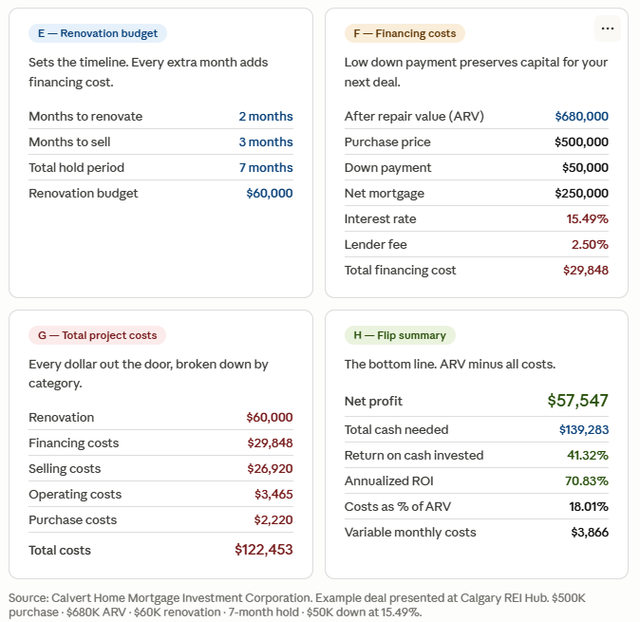
Their rates for flip financing are higher than conventional — Jesse referenced rates in the range of 7.99% to 17.25% depending on the deal — but these are short-term, interest-only products. An investor who completes a flip in 3.5 months at a 17.25% annual rate has effectively paid approximately 5% of that rate. The math works when the deal works.
A Word on Flipping vs. Long-Term Holding
An important clarification came up during the discussion: the rules for flipping and the rules for long-term buy-and-hold investing are fundamentally different, and conflating them leads to mistakes.
In a flip, the price you pay is everything. Overpaying even modestly compresses your margin and can turn a profitable deal into a breakeven or a loss.
In a long-term hold, you are optimizing for different things — cash flow, future appreciation, and the quality of the asset. If a property pencils as a rental and you plan to hold it for 20 years, paying $10,000 more for the right house (better location, better layout, better long-term demand drivers) can absolutely be justified. The market will reward good assets over time.
The BRRRR strategy (Buy, Renovate, Rent, Refinance, Repeat) sits somewhere in the middle. The goal is to force equity through renovation, rent the property for cash flow, and then refinance to pull out capital for the next deal. “Penciling” for a BRRRR means the property will cash flow once renovated and rented — not necessarily that you are buying at a discount to ARV. Jesse noted Calvert does significant volume with BRRRR investors and structures financing to support that strategy as well.
Foreclosures: Opportunity With Real Risk
Jesse addressed foreclosures directly when an audience member asked. His view: they can be great, but they are not the automatic bargain some investors assume.
Foreclosures are sold as-is, with no representations or warranties from the seller. The previous owner can damage the property right up until possession — and in extreme cases, that damage can be significant. The market typically discounts foreclosures by about 10%, which Jesse noted is usually an accurate reflection of the risk premium — no more, no less. A 10% discount is not a windfall; it is compensation for buying blind.
Additionally, in Alberta, buying a property with an existing tenant means the lease comes with it. That tenant must be dealt with — through a negotiated exit, cash-for-keys, or waiting for the lease to end — before you can renovate and sell. That process takes time and can significantly impact your project timeline. Jesse’s advice: take on foreclosures and tenanted properties once you have experience managing standard flips, not as your entry point.
FAQ
Q: Does financing become harder to get in a market downturn?
A: For private lenders like Calvert, the criteria for approving a flip loan does not change with market conditions. Their three-question framework — Is there profit? Can you execute? Do you have capital? — stays constant regardless of the broader market. On the conventional bank side, guidelines do not typically tighten dramatically in a downturn, but internal exceptions become harder to obtain and qualifying thresholds may shift. Jesse’s broader point: for a deal that genuinely pencils and has a qualified borrower, capital is almost always available. The issue in soft markets is usually not access to financing — it is finding deals that are priced right enough to make a profit.
It is also worth noting that Canadian lending oversight has real teeth. The Office of the Superintendent of Financial Institutions (OSFI) — the federal regulator responsible for overseeing Canadian banks — actually had to warn several major lenders for lending over 100% loan-to-value on Toronto condos using blanket appraisals. Banks were advancing $900,000 on units that had dropped to $700,000 in value, simply because that is what the unit sold for in 2022 and they were the ones who financed the original build. When no buyers could close, some banks issued blanket appraisals to paper over the problem rather than face the reality of the market. That is the kind of dynamic that erodes confidence in valuations — and it is exactly why understanding what a property is actually worth, independent of what a lender or appraiser tells you, matters so much.
Q: What neighborhoods and property types are performing well for flippers in the current Calgary market?
A: Jesse pointed to single-family homes in the $600,000 to $900,000 range in established, in-fill neighborhoods as the current sweet spot. Areas like Acadia, Glendale, and central-north Calgary were mentioned as active. He noted that the northeast Calgary market (previously strong in the $300,000–$400,000 range) has softened as newer housing stock and CMHC-backed purpose-built rentals have shifted more potential buyers into the rental market. On the higher end, investors with the capacity to renovate properties in the Willow Park and Bonavista area (buying just under $1M, renovating for $150,000–$200,000) are currently seeing strong margins. Condos were flagged as a market to avoid for flipping at this time due to oversupply.
Q: What is a reasonable minimum profit target on a flip?
A: Jesse framed this not as a fixed dollar amount but as a comparison to your alternative uses of time and capital. If you are a contractor doing renovation work at cost-plus 20%, you might make $10,000 on a $50,000 project. A flip should pay you meaningfully more than that to justify the risk, the capital at stake, and the coordination work on top of the physical labor. For a deal where the renovation budget is $60,000, Jesse suggested $30,000 in a worst-case, pessimistic scenario would be borderline acceptable — with more expected on a realistic scenario. The core principle: do not buy yourself a job. If the risk does not justify the return, walk away.
Q: Where do most flippers find deals — MLS, wholesalers, or off-market?
A: All three channels are in play. MLS deals exist, particularly when a listing is mispriced or sitting longer than it should (sometimes due to errors by an inexperienced listing agent). Wholesalers source off-market properties by door-knocking and running direct-to-seller marketing, then charge a margin to pass those deals to investors. Direct mail and Google advertising targeting sellers who want a quiet, as-is sale are also common. Jesse noted that sellers of properties that are good flip candidates — older homes in need of work, estate situations, hoarder properties — often specifically want to avoid the public market and a parade of open houses. Meeting them where they are, quietly, is where the best deals come from.
Q: Does Calvert lend in third position?
A: Yes, in certain creative financing structures. Jesse gave an example: a buyer negotiates a purchase-price discount with a seller who also agrees to a vendor take-back (VTB) — meaning the seller finances part of the purchase price rather than receiving it all in cash at closing. The buyer might also assume an existing first mortgage. In that structure, Calvert could come in as a third-position lender, provided the combined debt is not exceeding the property value and the deal is profitable. Jesse’s advice for new investors: start simple. Find a good property, secure standard first-position financing, and learn the fundamentals. Creative multi-position structures are a tool for experienced investors who have already mastered the basics.
Q: Does Calvert require an external appraisal?
A: Not typically. Calvert does its own in-house valuations, drawing on hundreds of ARV assessments per year and extensive follow-through data from completed flips. The only situations where they bring in a third-party appraisal are high-end properties (over approximately $1.5 million) and multifamily assets, where their in-house expertise is less specialized. For standard residential flips, their own valuations are both faster and — given their volume and feedback loop — arguably more accurate than what a general-practice appraiser would produce.
