
Key Takeaways
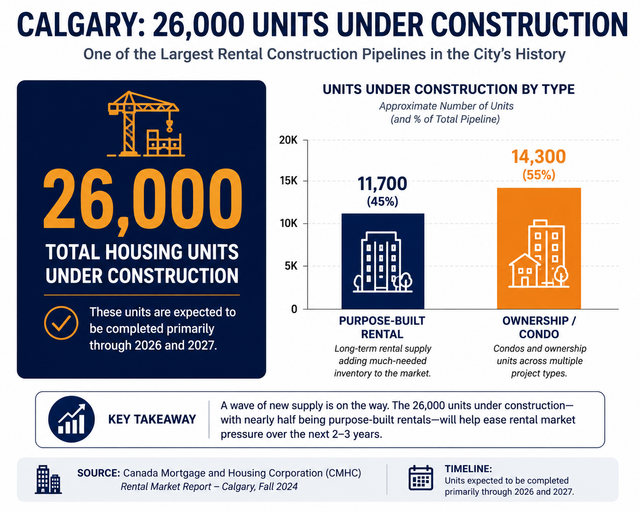
- Calgary has 26,000 units currently under construction — 45% of which are purpose-built rentals (Rental Units that had a legal suite built into it upon initial construction)
- L' apartment and townhouse/row sectors have seen the steepest price and rent drops; detached and semi-detached remain relatively resilient.
- Actual rent declines are closer to 15–20% from peak asking prices — significantly more than the ~5% widely reported in the media.
- Rents are expected to continue softening through 2026 and into 2027, driven by ongoing new supply hitting the market.
- Trying to time the market is largely futile — buying a good property in a good location matters far more than finding the perfect entry price.
- Alberta’s economic fundamentals — job growth, economic diversification, population growth, and a business-friendly regulatory environment — remain strong long-term tailwinds for Calgary real estate.
- Investors who own property today should focus on location quality, responsive property management, competitive marketing, and evaluating whether their current holdings still make sense.
- Opportunities are emerging in long-term buy-and-hold properties, distressed multifamily sales, and potentially deep-value condos as prices continue to correct.
Introduction
If you’ve been following the Calgary real estate market, you know the last few years have been a wild ride — from a pandemic-fuelled housing boom to record rent spikes, and now a very visible cooling off. At our most recent meetup, we laid out exactly where things stand today: the data, the honest assessment of what’s coming, and how to think about investing in this environment.
There are 26,000 units currently under construction in Calgary, with federal immigration targets effectively at or near zero — tells a lot of the story. But there’s more beneath the surface, and we want to make sure you understand both the risks and the opportunities clearly before making any decisions.
Calgary Is Canada’s Construction Capital (Relative to Size)
This isn’t a minor statistical footnote. In 2025, Alberta built nearly a quarter of all housing starts in Canada — despite having nowhere near a quarter of the national population. On the rental side, we’ve built almost triple the levels from ten years ago, and more rental units have been added in the last five years than in the prior thirty years combined.
Source: CMHC Housing Starts Report, January 2026; CBC News – Alberta 2025 Housing Starts
The Purpose-Built Rental Surge — And the Role of MLI Select
Of Calgary’s 26,000 units currently under construction, 45% are purpose-built rentals. In the apartment segment, that figure rises to 76%. So what drove this dramatic shift from condos to purpose-built rentals?
In our view, the biggest reason is CMHC’s MLI Select program, a mortgage insurance product for purpose-built rental construction and acquisition that offers higher loan-to-value ratios and amortizations up to 50 years in exchange for meeting affordability, accessibility, and energy efficiency criteria. The timing lines up: rental starts surged around 2021–2022, right when MLI Select gained traction.
For developers, building a rental apartment versus a condo apartment isn’t that different from a construction standpoint — what matters is where the money is. MLI Select offered financing so attractive that in Alberta, where the required rent-to-affordability thresholds were already relatively easy to meet given our lower baseline rents, developers could structure deals that actually pencilled better as rentals than as condo sales. Add rising rents at the same time, and you had a perfect incentive to build for the rental market.
“The MLI Select product is so good that it’s bad. It’s so good, especially in Alberta, where the market rents that you have to hit or the affordability ratios were already above what Calgary’s rents were. So it was really easy to take advantage of this product to get really preferential financing that actually made you money when you finish your build.” – Layne Walters
The result: we still have roughly as many condos being built as before — plus a wave of new rental units layered on top. When you stack both bars together, the total supply addition is significant, and it’s going to take time to absorb.
The Supply Pipeline Isn’t Stopping Soon
Even as new construction starts are expected to drop — CREB’s forecast calls for approximately a 35% decline in starts next year — the units already under construction will continue to hit the market for the next two to three years. Construction doesn’t stop the moment demand softens. Developers who’ve already committed capital, torn down existing buildings, and started foundations have to see projects through to completion, even if the economics have shifted under them.
CREB 2026 Forecast: Calgary ang Region Yearly Outlook Report
The Real Picture on Rents
The 5% Drop You Heard About? It’s Understated.
Most media coverage has been reporting a 5% year-over-year drop in Calgary rents, citing data from CoStar and similar providers — which draws from large apartment buildings and captures tenants who were never actually at peak rents. Many of those tenants signed leases years ago and never experienced the full run-up, so their reported rents don’t reflect what landlords trying to re-rent a unit today are actually seeing.
Our friend and colleague Larry Lee — a commercial mortgage broker with deep CMHC expertise — didn’t believe that number either. So he started tracking it himself, recording daily data from Rent Faster over a two-year period. What he found: asking rents are down approximately 15–20% from their peak, depending on unit type. Basement one-bedrooms have seen the sharpest drop, around 20%. Most other types are down roughly 15%.
If you’ve re-rented a unit recently, that probably matches what you experienced on the ground.

When Did the Peak Happen — And Where Are We Now?
The peak was brief. If you rented a property in early 2024, that was roughly the top of the market. The peak didn’t last long — supply caught up relatively quickly. If you rented a unit in early 2022 and your tenant is just leaving now, you’re likely still roughly even or slightly up from where you started.
The pain is concentrated among investors who rented at peak — late 2023 through 2025 — and are now re-renting into a much softer market. Our estimate is that we’re already through about half of the total correction. Peak-to-trough, we think a 30% decline from the absolute peak is plausible — we’ve seen roughly 15% of that already. The bottom is likely around 2027, after which we expect rents to stabilize and start recovering.
Importantly, even at the bottom, rents are expected to remain well above 2019 levels. This isn’t a return to pre-boom pricing.
More Supply Is Still Coming
CoStar’s forecast shows continued significant net deliveries of multifamily units for at least the next two to three years. Even if new starts are declining, units already in the pipeline will continue to hit the rental market throughout 2026 and 2027. This is the primary reason we believe rents will keep softening before they stabilize.
What About Prices? The CREB Forecast
CREB’s 2026 price forecast calls for further declines in the apartment and row/townhouse segments — which have already seen corrections. For detached and semi-detached, the official forecast is roughly flat.
Our read: the flat forecast for detached and semi-detached is realistic, but possibly a touch optimistic. We think single-digit price drops of a few percentage points are also possible, given the added supply pressure. That said, even in a modest correction scenario, detached prices remain substantially higher than they were in 2021–2022. The gains from 2022 and 2023 alone — roughly 15% per year — are not fully given back even under a cautious scenario.
As for cap rates (Capitalization rate: a measure of investment return calculated as net operating income divided by property value. A lower cap rate indicates a higher property value relative to income; a higher cap rate indicates a lower value), CoStar forecasts a modest decline, which would be a positive for multifamily property owners as compressing cap rates increase asset values — partially offsetting the pressure from lower rents. Whether that plays out remains to be seen.
Can You Time This Market? (And Should You Try?)
Every cycle, people start doing the math on when to buy. Wait for the bottom, buy cheap, ride the recovery up. It sounds logical. In practice, it’s nearly impossible to execute.
You should buy when you’re ready to buy. It includes being able to handle a downturn… if you’re requiring to make $150 a month cash flow and you couldn’t handle it going to -$200 for a year and a half, then you shouldn’t buy if your numbers are that tight.
By the time the bottom is obvious, every other investor has reached the same conclusion. Competition picks back up, the best properties get multiple offers, and whatever price advantage you were waiting for evaporates. You end up buying a less desirable property at a “better” price — and the quality gap hurts you more over the long term than the savings help.
We’ve both bought properties this year. Not because the market is great — it isn’t, especially on the rent side — but because the right properties came along and we had the financial capacity to absorb a short-term dip in cash flow.
The Long-Term Case for Calgary Real Estate
The short-term picture is genuinely challenging: rents are down, supply is elevated, and there’s uncertainty around immigration and the broader economy. We want to be straight with you about that. But the longer-term fundamentals for Calgary and Alberta are, in our view, as strong as they’ve ever been.
A few things worth highlighting:
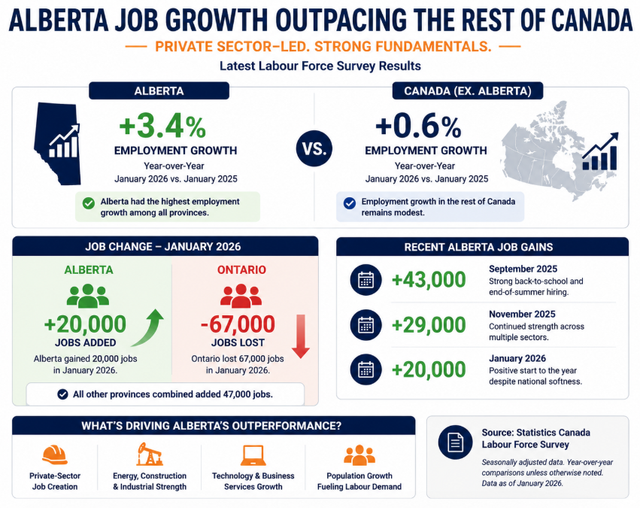
- Job growth: Alberta added approximately 20,000 full-time jobs in a single month while the rest of Canada struggled — and if you strip Alberta’s numbers out of the national figures, Canada actually lost jobs. Two-thirds of Alberta’s job growth is private sector, which means real economic activity, not government payroll expansion.
- Economic diversification: Alberta has shed 10,000 oil and gas jobs over the past year, yet employment continued to grow. Tech, fintech, logistics, agribusiness, aerospace (de Havilland’s decision to relocate and build manufacturing from scratch in Alberta is significant), and now data centres and lithium extraction are all contributing to a much more diverse economic base.
- Lithium: Alberta sits on substantial lithium reserves — and critically, already has the infrastructure, chemical engineering expertise, and industrial processes to extract it economically. E3 Lithium is developing the first commercial-scale extraction operation in the province. This is a global resource in high demand, and Alberta has a meaningful head start.
- Data centres: Alberta’s deregulated electricity market means companies can build their own power generation without years of regulatory battles. A $10-billion data centre investment has already been proposed north of Calgary. Premier Smith has announced a target of $100 billion in data centre investment — and the regulatory path to get there already exists.
- Population growth: Calgary hit 1 million people when Layne moved here 20 years ago. We’re now at 1.6 million. Stats Canada projections show Calgary with the highest growth rate of any major Canadian city on one-, five-, and ten-year horizons. Alberta is expected to surpass BC in population within approximately ten years.
- Affordability gap vs. Toronto and Vancouver: Calgary incomes have grown faster than Toronto’s over the same period, yet our home prices remain dramatically lower. There’s no fundamental reason those two numbers shouldn’t converge over time. That gap is potential upside.
- Tariff exposure: US tariffs are a real concern for Canada, but Alberta’s exposure is comparatively limited. We export resources the US needs — oil, gas, lithium, power capacity — not manufactured goods competing with American industry. Ontario’s manufacturing sector faces a much more direct threat. Alberta is a resource the US wants, not a competitor they’re trying to protect against.
How to Navigate This Market as an Investor
If You Own Investment Properties Today
Prioritize location and quality. In a hot market, tenants will compromise — they’ll rent in a neighbourhood they wouldn’t normally choose, or take a unit with a less-than-ideal layout, because it’s all they can afford. In a balanced or soft market, they have options again. Good location, functional layout, and well-maintained units hold their occupancy much better than lower-quality alternatives — even at a similar rent level.
Respond to inquiries fast. A few years ago, tenants were chasing you. Now the dynamic has flipped. If you don’t follow up quickly, they’ll move on to the next listing. Speed matters.
Invest in marketing. Professional photos and a 3D tour cost a few hundred dollars and can pay dividends for years — especially after a renovation. The difference in quality between good and bad rental listing photos is stark, and it directly affects how quickly you fill vacancies and at what rent.
Consider rent incentives before rent cuts (for larger properties). For multifamily properties valued on a net operating income basis, reducing the stated rent has a direct negative impact on your appraised value. Offering one to three months free as a lease-up incentive can be a better strategic move if you’re considering refinancing or selling in the near term. For single-family rentals, this math is different — just price competitively and get the unit leased.
If your unit is vacant, plan renovations now. Trades are becoming more available. Renting a renovated unit in a soft market commands a much bigger premium over non-renovated units than it does in a hot market. The gap in rent uplift from a renovation is wider when tenants have choices.
Evaluate your portfolio honestly. Ask yourself: would I buy this property today, at today’s price, knowing what I know about current rents? If the answer is no, that’s important information. It’s psychologically difficult to sell at a loss, but compounding a bad investment over time makes the outcome worse, not better. Condos in particular warrant a hard look — a fully paid-off condo with strong cash flow can still be a poor return on equity if that capital could be redeployed into land-backed assets.
If you have a bad investment property, don’t hold on to it… if you could improve that cash flow, if you could improve those returns, you’re just compounding the problem longer.
Emerging Opportunities Worth Watching
- Long-term buy-and-hold: The core of what we do and what we recommend. Good properties in good locations are available with less competition than in recent years. If you have the financial capacity to absorb short-term cash flow pressure, this is a reasonable time to buy.
- Long-term multifamily owners looking to exit: We’re seeing more of these properties coming to market — buildings held for 20–40 years by owners who are looking to wind down. Many are well-maintained. Some are underperforming relative to their potential due to below-market rents under long-standing tenancies. These can be strong acquisitions for investors willing to work through the lease-up process.
- Deep-value condos (selectively, in the future): We’re generally not fans of condos as rental investments, but as corrections deepen, some units may become attractive — particularly for buyers who plan to occupy them. If you’re in the market for a personal residence, there will be some motivated sellers. Make lots of offers. Don’t be afraid to negotiate hard.
- Distressed new-build multifamily: Some investors purchased new multifamily units using rents in pro formas that never actually existed — projections that exceeded even peak asking rents. As those leases come up and real-world rents prove out, some of these properties will come under pressure. Opportunities for creative deal structures, loan assumptions, or below-replacement-cost acquisitions may emerge — though the question mark remains on how many sellers will actually have the ability (and the will) to transact.
- BRRR (Buy, Renovate, Rent, Refinance — a real estate investment strategy where an investor purchases a property, renovates it, rents it out, and then refinances to pull out equity and repeat the cycle) over flip: Flipping in today’s market carries more risk with less margin for error. A BRRR approach allows you to renovate a property, build forced equity, and stabilize it as a rental — with the optionality to sell later if the market improves. You’re not forced to exit in a soft market.
We help clients find and evaluate rental properties to suit their means and investment strategy. Book a call with us today
The Bottom Line
We started this presentation with some uncomfortable truths about rents and supply, and we’ll end with the same honest framing: 2026 and likely much of 2027 will be challenging for Calgary rental investors, particularly in the apartment and row housing segments. Rents are still falling. Supply is still being delivered. That’s real, and you should plan for it.
At the same time, we’re both still buying. Not because we’re ignoring the near-term headwinds, but because we’ve learned — across multiple cycles — that the best properties tend to get acquired in exactly these conditions. Less competition, more inventory, sellers who need to transact. The long-term fundamentals of Calgary and Alberta are genuinely strong, and they don’t get invalidated by a 12-to-24-month soft patch in the rental market.
If your finances can absorb a period of reduced or negative cash flow, and you find a property that checks the right boxes for the long term, there’s a reasonable case for buying now. If your numbers don’t have that cushion, wait until they do. Either way — be honest about where you stand, and don’t let anyone — including us — talk you into a deal that doesn’t make sense for your situation.
FAQ
Q: Should I be worried about foreclosures in Alberta?
A: Not in the way you might expect based on what’s happening in other provinces. Alberta homeowners have built significant equity over the past several years — for many, this is the first time they’ve had meaningful equity in their properties. As a result, when financial stress hits, there are options: sell, pull equity, or refinance. CMHC data shows Alberta foreclosures are currently at statistically immeasurable levels. Job losses, divorces, and other life events still cause individual cases, but broadly, Alberta’s foreclosure situation is much healthier than Ontario or BC.
Q: What about the impact of US tariffs on Calgary real estate?
A: Alberta’s exposure to US tariffs is relatively limited compared to other provinces — particularly Ontario, which has significant manufacturing competing directly with the American Midwest. Alberta primarily exports resources that the US needs: oil, gas, and increasingly lithium and energy capacity. These aren’t areas where the US is looking to protect domestic industry through tariffs. That said, broader economic uncertainty from the tariff environment can affect consumer and investor confidence, which is worth monitoring.
Q: When do you think rents will bottom out?
A: Our current thinking is that 2027 is likely when we see the rental market bottom, with stabilization and gradual recovery to follow. The two key drivers are supply and demand: supply will continue coming online through 2026 and into 2027 (projects already underway), while immigration policy may begin shifting again as the economic effects of the current near-zero targets start to show up in the data. We want to be clear — we don’t have a crystal ball, and this is our best read of current conditions and trends, not a guaranteed forecast.
Q: What immigration targets are you referencing, and what’s the impact?
A: The federal government has significantly reduced immigration targets in response to the rapid population growth Canada experienced over the past several years. Effectively, targets have been brought close to zero for a period to allow the system to rebalance. This matters for real estate demand: fewer new arrivals means less pressure on rental supply, which contributes to the softening we’re seeing in rents. If the economy deteriorates, we’d expect the government to ease those targets again — which would be a positive for rental demand.
See the Government of Canada’s website for more information about federal immigration target changes.
Q: You mentioned the CREB forecast showed price drops for apartments but flat for detached homes — do you agree?
A: We think CREB’s forecast for the apartment and row segments is reasonable — those have already seen corrections and the supply pressure is clear. For detached and semi-detached, CREB is forecasting roughly flat. We think that’s plausible, but possibly a bit optimistic — a few percentage points of further decline isn’t out of the question given overall market conditions. That said, even a modest correction leaves detached prices far above 2021–2022 levels. The big run-up of 2022–2023 (approximately 15% gains per year) would not be fully given back even under a cautious scenario.