
Layne is a Co-Host of the Calgary REI Hub Meetup, Real Estate Investor, and Mortgage Broker at Your Mortgage Team
Key Takeaways
- Sales volumes are down year-over-year across Calgary, while months of inventory, average days on market, and benchmark prices are all trending up — apartments and rowhouses are seeing the sharpest inventory increases.
- Tariffs on steel, aluminum, and the auto sector — plus Chinese tariffs on Canadian canola, seafood, and meat — are adding inflationary pressure, and the Bank of Canada’s own survey shows a growing share of firms bracing for a recession.
- Rents are coming down across most property types, driven largely by a wave of new supply from CMHC’s MLI Select program, which was originally designed for less-affordable cities but ended up fueling a construction boom in Alberta.
- If you’re selling, price competitively from day one. If you’re buying, run your numbers conservatively and account for today’s (lower) rents, not last year’s.
- Long-term investors (5+ years) are in a much stronger position than flippers or short-term speculators, who are more exposed to this kind of market shift.
- Inflation, over the long run, tends to favour real estate investors who bought with debt — because while asset values rise with inflation, the debt used to buy them does not.
- Alberta’s economic fundamentals — population growth, a strong labour participation rate, growing tech and private-sector job creation, and comparatively low government debt — continue to support the case for investing here.
- Expect the rental oversupply (much of it tied to MLI Select construction) to work through the system over roughly the next 12 to 18 months before the market finds its floor.
Introduction
Every real estate cycle has a moment where the mood shifts — where the frenzy of bidding wars gives way to a market that rewards patience and preparation instead. Calgary is in that moment right now. At our latest Calgary REI Hub meetup, we broke down where the market actually stands heading into the back half of 2025, what’s driving the shift, and — maybe more importantly — how investors should be positioning themselves for what comes next.
This isn’t a doom-and-gloom update, and it isn’t a “nothing to see here” update either. It’s a realistic look at rising inventory, softening rents, tariffs, inflation, and why none of that changes the fundamental case for long-term real estate investing in Calgary.
Where the Calgary Market Stands Right Now
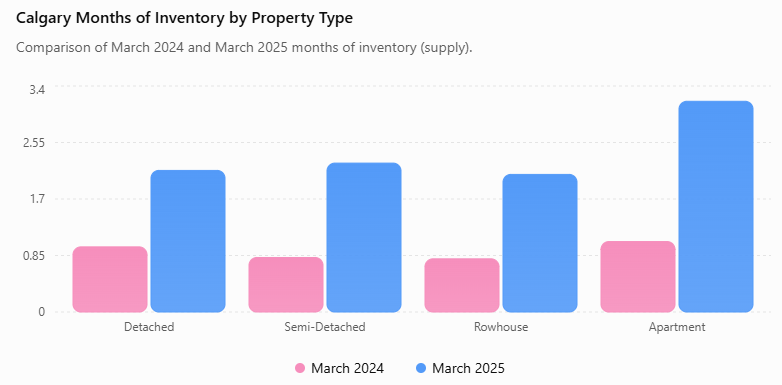
Looking at March 2025 data across all residential property types, the trend is consistent: sold listings are down year-over-year, while months of inventory, average days on market, and benchmark sale prices are all climbing.
- Detached and semi-detached homes: Benchmark prices are still higher than this time last year, but months of inventory is up roughly 120% for detached and 170% for semi-detached homes. Prices haven’t dropped meaningfully yet, but with that much inventory sitting unsold, there’s a real chance we see downward pressure.
- Rowhouses and apartments: Apartments in particular have seen close to a 200% increase in months of inventory. Expect that number to keep climbing given how much supply is currently under construction — much of it purpose-built rental and condo product that can take anywhere from one to five years to actually hit the market.
What is “Months of Inventory”?
Months of inventory is a measure of how long it would take to sell off all the current listings in a market at the current pace of sales, assuming no new listings were added. A rising number means homes are taking longer to sell and buyers have more selection — a classic sign of a market shifting away from sellers and toward buyers.
“Benchmark price” is a standardized measure used by real estate boards (like CREB) to track typical home values in a market over time, adjusting for differences in home size, age, and features — it’s generally considered a more reliable gauge of price trends than a simple average or median sale price.
Tariffs, Inflation, and the Broader Economic Picture
Canada has fared better than many countries when it comes to tariffs, but we haven’t come away unscathed. Steel, aluminum, and the auto sector are still affected, and on top of that, China has placed tariffs on Canadian canola oil, seafood, and meat exports — creating a squeeze from two directions at once.
The Bank of Canada’s Business Outlook Survey, which interviews roughly 500 of the country’s largest firms, found that 32% of businesses were planning with the expectation of a recession in the coming year — up sharply from 15% over the prior two quarters. Bank of Canada, Business Outlook Survey — First Quarter of 2025
If tariffs stay in place, the expected outcome is inflation — input costs and selling prices rise, sales in Canada trend lower, and unemployment starts to tick back up after having improved through the back half of 2024.
What’s Happening With Rents
If you own rental property in Calgary and have tried to re-rent a unit recently, you’ve likely noticed it’s taking longer, or you’ve had to lower your asking rent to get it filled. Month-over-month data shows rents trending down across most property types — townhouses, apartments, main floors, and basement suites alike.
The main driver is supply. A wave of purpose-built rentals is under construction across the city, and many new suburban communities are being built with basement suites as a standard feature. Redstone was called out as one example — a community with a high concentration of basement suites where rents have dropped more sharply than in other parts of the city, simply because supply has outpaced demand there.
This is also changing seller behaviour. A good example: Huntington Hills currently has 16 detached properties listed for sale, compared to an estimated four at the same time last year — and eight of those 16 are suited (income) properties. Investors who bought at the rental peak, expecting rents to hold, are now deciding to sell rather than ride out lower cash flow.
Why Rents Are Softening: The MLI Select Factor
MLI Select is a CMHC (Canada Mortgage and Housing Corporation) mortgage insurance program for rental properties with five or more units. It allows for up to 95% financing and amortizations of up to 50 years in exchange for meeting affordability, accessibility, or energy-efficiency commitments — a far more generous structure than the roughly 65% loan-to-value typically available through conventional multi-family lending. Source: CMHC — MLI Select
The program was designed with cities like Toronto and Vancouver in mind, where affordability is a serious problem. But Alberta’s rents were already comparatively affordable, which meant builders here could qualify for MLI Select financing without needing to discount rents much at all — and that made the program extremely profitable to use. As a result, builders from across the country, including medium-sized builders who relocated from other provinces, poured into Alberta to take advantage of it.
“So it wasn’t people weren’t doing this like building these because the market dynamics of the rent were supporting it. They were doing it because of the financing.” – Layne Walters
The financing was structured in a way that some builders could profit from the construction and financing itself, before ever collecting a dollar of rent — which meant projects kept getting built even as the underlying rental math grew less favourable. That’s a big part of why rental completions are up 160% (data from Build Calgary), and why we expect months of inventory in the apartment sector to keep climbing.
How to Prepare, Whether You’re Buying or Selling
If You’re Selling
- Price competitively from the outset. The old approach of pricing high and adjusting downward later is far less effective in a market with this much competing inventory — it just means you chase the market down and risk becoming a stale listing.
- Expect to be compared directly against similar listings in your area, which reinforces the need to price right the first time.
If You’re Buying
- It’s not a bad time to buy — negotiating power has shifted meaningfully toward buyers.
- Run your numbers conservatively. If a tenant-occupied property is currently renting for $2,000/month, don’t assume that holds — today’s comparable rent might be closer to $1,700–$1,800.
- Factor in rising costs, especially insurance, which has increased significantly in Alberta — in some cases nearly doubling on renewal, partly attributed to hail damage claims. Shopping around can still turn up a reasonable rate.
- If you’re buying a commercial or MLI Select-eligible property (5+ units) with a long closing timeline, build in a reserve fund. If achieved rents come in lower than what CMHC underwrote — say, 15% lower — your loan-to-value could be reassessed, potentially requiring a larger down payment or proof of pre-leasing to hit the required rents.
- New construction in the suburbs — a primary residence, or a semi-detached/detached home with a legal suite — is a good opportunity right now, with builders showing real willingness to negotiate. As one example, a builder representative offered a $30,000 discount off the posted price after a single phone conversation.
Layne’s Perspective: Why Long-Term Investing Wins
Layne Walters has been through three real estate cycles as both an active investor and a mortgage broker, and his take is straightforward: buy-and-hold investors build wealth over time, while flippers rarely last, because eventually the market catches up with them.
“Anything five plus years is real estate investing. Anything less than five years, in my opinion, I would consider it speculating.” – Layne Walters
That’s a meaningful distinction. Flipping, in Layne’s view, isn’t really real estate investing at all — it’s a construction business that happens to involve real estate. It’s active income, taxed as such, and it requires you to stay actively engaged rather than benefiting from the passive, compounding nature of long-term ownership.
Inflation Is Good for Real Estate — Here’s Why
One of the more important concepts from the presentation: inflation raises the price of everything — gas, groceries, wages, and houses. On its own, that doesn’t make you wealthier, since a higher-value house doesn’t buy you more milk if milk costs more too. The part that actually benefits real estate investors is that the debt used to buy the asset does not rise with inflation.
If you buy a $500,000 house with debt, and both the house value and everything else in the economy doubles, your debt is still $500,000 — which is effectively half its original value in today’s dollars. The asset’s price rises with inflation, but the debt gets quietly devalued. Governments, carrying enormous debt loads themselves, have strong incentive to let inflation run rather than cut services or raise taxes enough to pay down debt outright — which is part of why long-term real estate investors have historically benefited from this dynamic.
It’s worth noting this doesn’t happen in a straight line. Rents, for example, don’t move up in lockstep with grocery prices — they tend to rise in bands, often catching up after wage increases make higher rents affordable. A recent 20% wage increase for Alberta’s nurses’ union over four years was cited as one example of the kind of wage pressure that can eventually support higher rents down the line, even if it doesn’t happen immediately.
Alberta’s Underlying Economic Strength
Despite the near-term softness in rents and rising inventory, several structural factors support Alberta’s economy and, by extension, its real estate market:
- Population growth: Alberta continues to see strong population growth from births exceeding deaths (a byproduct of having the youngest population among the provinces), along with continued interprovincial and international migration.
- Labour market: Alberta has a uniquely high labour force participation rate, meaning it can post both a high unemployment rate and a high employment rate at the same time — more of the population is actively working or looking for work compared to provinces like Ontario or Quebec.
- Job growth outside oil and gas: Alberta’s recent job growth has been driven largely by the private sector, including a notable shift of oil-and-gas trained workers (already skilled in math and coding) into the tech sector.
- Low government debt relative to GDP: Alberta’s debt sits at roughly 42% of its annual GDP — far below Ontario’s, giving the province significantly more room to support infrastructure spending if needed.
- Office vacancy as an economic asset: With roughly 30% office vacancy downtown — more vacant office space than the entire office market in Vancouver — companies looking to expand can access very inexpensive office space in Calgary for the foreseeable future, which has helped attract tech-sector expansion into the city.
[VISUAL: A simple comparison chart of provincial government debt as a percentage of GDP (Alberta, Ontario, BC, Saskatchewan), to illustrate Alberta’s relative fiscal capacity.]
Interest Rates: What to Expect
As a mortgage broker, Layne fields interest rate questions constantly, and his expectation is that rates will generally trend lower — not necessarily because economic fundamentals demand it, but because Ontario’s housing-driven economy is under real strain as ultra-low pandemic-era mortgages renew into much higher rates, pulling significant spending power out of the largest component of Canada’s GDP: consumer spending.
He also expects the Bank of Canada may hold steady on rates in the very near term to project stability, before continuing to lower rates afterward — potentially alongside further quantitative easing to support fixed rates.
FAQ
What’s driving the increase in housing inventory — is it mostly investors selling?
Investor selling is a factor, but likely a smaller one. Slowing immigration and a wave of mortgages renewing into higher interest rates are bigger contributors — when homeowners see their new mortgage payments, some decide it’s a good time to sell, particularly if they believe the market may have already peaked. A large share of five-year mortgage terms are renewing through this summer, adding to that dynamic.
Why did Alberta build so much housing if population growth is now slowing?
Alberta reacted quickly to rising rents and rapid population growth by ramping up construction — a natural response in a province with comparatively light regulation. But federal immigration targets shifted abruptly, and there’s a lag between when people plan a move to Canada and when they actually arrive, meaning some of the anticipated demand hasn’t shown up as quickly as expected. The result is a temporary oversupply that will take time — roughly 12 to 18 months, by this estimate — to be absorbed.
Will converting downtown office buildings into residential units meaningfully affect housing supply?
Not significantly. Office-to-residential conversions face real physical limitations — buildings need a narrow enough footprint to provide adequate window access to units, which rules out most larger office towers. The volume involved (hundreds of units) is small compared to the tens of thousands of units already in the pipeline from new residential tower construction downtown.
The Bottom Line
Calgary’s market is shifting — more inventory, softer rents, and real economic uncertainty tied to tariffs and a slowing broader economy. None of that changes the fundamental case for long-term real estate investing here. If you’re buying, be conservative with your numbers and prepare for some negative cash flow in the short term. If you’re selling, price to compete rather than hoping the market comes back to you. And if you’re investing for five-plus years, the underlying fundamentals — population growth, a resilient labour market, and comparatively strong provincial finances — still make Calgary a market worth being in.
If you’d like to talk through how these market conditions apply to your specific portfolio or purchase plans, reach out to the Calgary REI Hub team — we’re happy to help you run the numbers.