Key Takeaways
- Calgary’s housing market is softening overall. Benchmark prices are edging down, days on market are rising, and sales are slowing.
- The northeast and east quadrants are seeing the largest price declines, largely because they rose the fastest during the last run-up.
- Detached and semi-detached homes are holding up best. Condos and townhouses face the most pressure from new supply.
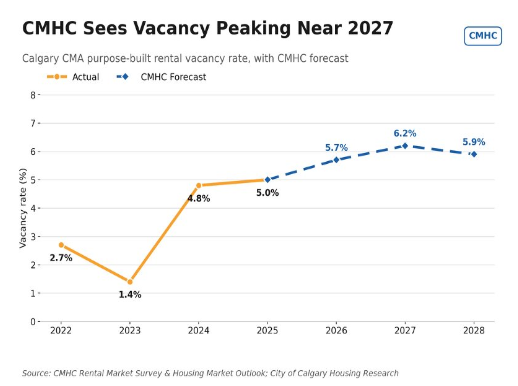
- Rents are trending down and vacancy is expected to keep rising into 2027 as MLI Select and infill projects finish construction.
- Cash flow is still possible, but it takes the right property and a value-add plan: legalizing suites, adding garages, and moving utilities to tenants.
- Alberta’s fundamentals are strong: leading job growth, a diversifying economy, and large planned energy and data centre investments.
- Downturns are often the easiest time to buy quality long-term properties, as long as you stress test your numbers and keep a cash cushion.
- Multi-family values are more sensitive to falling rents than single-family homes, so they need a bigger buffer right now.
Introduction: Where Calgary Real Estate Stands This Fall
If you follow Calgary real estate headlines, you have probably noticed the tone has shifted. After several years of rapid price growth, record migration, and tight rental conditions, the market is cooling. Prices are softening in some segments, rents are coming down, and a wave of new rental supply is still working its way through construction.
For investors, that raises fair questions. Is now a bad time to buy? Can anything still cash flow? Should you wait it out?
At our monthly Calgary REI Hub meetup, we covered three things: the current state of the Calgary housing and rental market, what is driving supply, and why we are still optimistic about Alberta over the medium and long term. We also walked through real numbers on properties that cash flow today. Here is what we shared.
Calgary Housing Market Update: Fall 2026
Across total residential properties, the general trend is a slow decline. Benchmark prices are drifting lower, days on market are increasing, and the number of sales is down.
Benchmark price is the price of a “typical” home in a given area and property type, based on a set of standard features. It gives a cleaner picture of price trends than average or median sale prices, which can swing depending on what happened to sell that month.
CREB September 2026 data: total residential benchmark of $566,700, down about 0.8% year over year. Detached $739,400 (down about 1%), semi-detached $685,200 (up 0.1%), row $412,400 (down 5.5%), apartment $291,400 (down 8.3%). Source: CTV News / Canadian Press, Oct 1, 2026. Full report: CREB.
The Northeast and East Are Seeing the Biggest Price Declines
When we break the city down by quadrant, the largest declines are on the east side, particularly the northeast, followed by the east quadrant.
There is a simple reason. These were the quadrants that went up the most over the past few years. They started as the most affordable areas in the city, so when money and people poured into Calgary, the lower-priced homes rose fastest. Now they are giving back some of those gains first.
CREB September 2026 quadrant data: northeast detached benchmark down 6.01% year over year to $556,600; east down 4.99% to $476,200. Source: Daily Hive, Oct 1, 2026.
Detached and Semi-Detached Homes: Holding Steady
For detached homes, benchmark prices are close to flat, possibly down slightly. Semi-detached (half duplex) prices are essentially flat as well.
What has changed is days on market. Semi-detached homes in particular are taking noticeably longer to sell than they used to, and we see this in our own listings day to day. Supply for semi-detached properties is also climbing.
One saving grace stands out: properties with income potential. Homes with a basement suite, or a garage that can be rented out, are still selling faster than comparable homes without any income-generating features. On the investor side, detached homes with suites have held their value well.
Townhouses and Condos: Under the Most Pressure
It should not surprise anyone that Calgary’s condo market is struggling. Months of inventory for townhouses is up 23% year over year. For apartments, it is up 6% year over year, on top of increases that had already happened before that.
Months of inventory measures how long it would take to sell all current listings at the current pace of sales, assuming no new listings come on. Higher numbers mean more supply relative to demand, which typically favours buyers.
More new condos and apartments are still coming. Our view is that it will likely take a few more years for this influx to be absorbed before the condo segment returns to more balanced conditions.
Calgary Rental Market: Rents Down, Vacancy Up
Rental data from RentFaster.ca for September shows most unit types (studio through four bedroom) on a declining trend. Apartments, which in that data set also include some basement suites, are almost all trending down. Broader rent tracking across all residential rental types shows the same direction.
Why Calgary Needs a Higher Vacancy Rate Before Rents Stabilize
CMHC publishes a mid-year rental market update. It estimated Calgary’s vacancy at around 5% as of the middle of this year. One interesting note from that report: Calgary and Edmonton need higher vacancy rates than other Canadian markets before rents stabilize. Below that threshold, the market tightens quickly and rents rise fast.
Vacancy rate is the percentage of rental units that are empty and available to rent at a given time. Traditionally, about 3% has been considered “balanced.” CMHC now suggests Calgary’s balanced range is higher than that.
CMHC, 2026 Mid-Year Rental Market Update (June 2026), notes Calgary and Edmonton require higher vacancy rates before average rents stabilize: CMHC.
Vacancy Is Expected to Peak in 2027
CMHC expects vacancy to keep climbing. Its forecast for Calgary is roughly 5.7% for 2026, peaking around 6.2% in 2027.
The 5.7% (2026) / 6.2% (2027) figures match CMHC’s earlier Housing Market Outlook as cited by the City of Calgary housing trends page. CMHC’s Summer Update: 2026 Housing Market Outlook revised 2026 to 5.9%, with 2027 still at 6.2% (Mortgage Professional Canada). Reviewer: decide whether to update to 5.9%.
A big part of this is supply still under construction. Many MLI Select projects and infill builds (8-unit and 12-unit buildings, for example) have not hit the market yet. When they do, they will all need tenants. That likely pushes vacancy a bit higher before things improve.
Can You Still Find Cash Flow in Calgary? Yes, With the Right Strategy
With all that said, the question we hear most is whether anything still cash flows. The answer is yes. But you may need to adapt your approach.
“Can you still get something that cash flows in the city? And the answer is yes. But you might have to adapt your strategy slightly.” – Santhosh Nathan 00:06:38
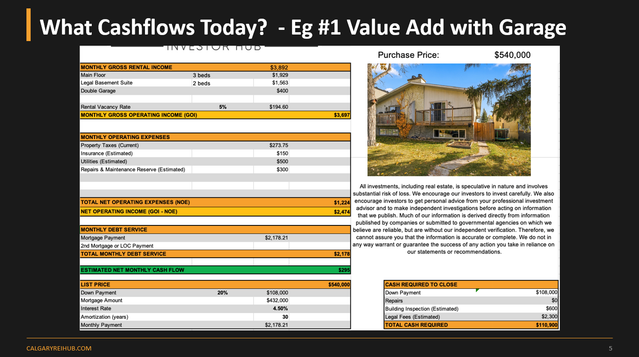
Here are three real examples. All use a 4.5% interest rate, and the first includes a 5% vacancy allowance and $300 per month set aside for repairs and maintenance.
Cash flow is what is left each month after rent comes in and all expenses go out: mortgage payment, property tax, insurance, utilities you cover, repairs and maintenance reserves, and vacancy allowance.
Example 1: Bowness Semi-Detached With a Legal Suite
This is an active listing of ours: a semi-detached home in Bowness (northwest) with three bedrooms up and a two-bedroom legal basement suite, listed at $500,000.
- Fully tenanted: $1,929 per month upstairs and $1,563 downstairs, with utilities included
- Actual property tax, estimated insurance, plus repairs and vacancy reserves
- Cash flow at 4.5%: about $77 per month
That is not huge, but it is positive after conservative reserves. Here is how to improve it. The property has a two-car parking pad. If you spend about $40,000 to build a double garage (modelled here as a purchase price of $540,000), that garage can bring in roughly $400 more per month. Cash flow rises to close to $300 per month.
The garage also builds resilience. Without it, if rates rose to 5%, the property would be about $40 per month negative on paper. With the garage, it still cash flows at 5%.
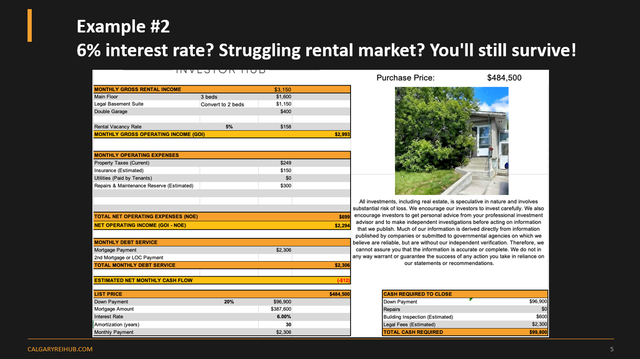
Example 2: Acadia Up/Down With an Illegal Suite
This was a purchase we helped a client with in Acadia, in the southeast. It was bought for $414,500. It had an illegal suite and some wear and tear inside.
The long-term tenants were paying $1,750 upstairs and $1,100 downstairs, with utilities included. At 4.5%, the property was negative cash flow on day one. On the surface, many investors would pass.
Here is the turnaround plan:
- Spend about $30,000 to legalize the basement suite and refresh the property (paint, a few cabinets, general fixes).
- Build a garage on the existing parking pad and rent it out for about $400 per month.
- Move utilities to the tenants, either through a 60/40 split or a flat utility fee on top of rent.
With market rents of $1,750 up and $1,250 down (tenants paying utilities), plus garage income, and the purchase price modelled $70,000 higher to account for the work, cash flow lands around $577 per month.
We also stress tested this one. Even in an extreme scenario with a 6% interest rate and lower rents, the property roughly breaks even. That is the kind of resilience we want to see in this market.
Example 3: Temple (Northeast) Legalized Under the Amnesty Program
Our last example is in Temple, in the northeast, the quadrant with the largest recent price declines. Our client bought it for $388,500 with two bedrooms up and two bedrooms in the basement. The suite was illegal, and he legalized it through the City of Calgary’s secondary suite amnesty program.
- Rents: $1,500 up (current market rent) and $1,200 down
- Tenants pay utilities
- Cash flow at 4.5%: a little over $200 per month
It may not be the most sought-after location, but at that purchase price, it cash flows.
Secondary suite amnesty program: a City of Calgary program that waives development permit and registration fees, and allows relaxed (minimum life-safety) building code requirements, for owners legalizing suites built before March 2018.
The City extended the amnesty to December 31, 2026: City of Calgary Newsroom. Reviewer: the deadline is roughly two months out. Consider adding a timely note or linking to calgary.ca/suites.
Why We Love Garages
Garages came up repeatedly. Rentable garages and similar storage spaces tend to be very profitable, with minimal turnover and very little to maintain. A kitchen needs updating every so often. A garage is still a garage 20 years later.
The key is to apply value-add strategies to the right property. If a home’s realistic top-end market value will not support the investment, the improvements may not make sense. That is why we review each property individually before recommending this approach.
What Is Driving Calgary’s Housing Supply
Rental Starts Now Make Up About Half of New Construction
Looking at housing starts in Alberta’s larger centres (Calgary, Edmonton, Red Deer, Lethbridge, and other centres over 50,000 people), there has been a major shift. From 2001 to about 2021, purpose-built rental starts were marginal compared to homeownership starts. Today, roughly half of all starts are purpose-built rentals.
A big reason is MLI Select. It offers financing with up to a 50-year amortization and as little as 5% down, at very good interest rates, because it is a CMHC-insured product. Developers and many investors love it. It has also pulled construction away from the ownership market. Instead of building a condo tower and selling units, many developers now rent the building out.
MLI Select is a CMHC multi-unit mortgage loan insurance product for buildings with five or more units. It uses a points system based on affordability, energy efficiency, and accessibility. More points unlock higher loan-to-value, longer amortization, and lower insurance premiums. Amortization is the total time it takes to pay off a mortgage. CMHC is Canada Mortgage and Housing Corporation, the federal housing agency.
CMHC MLI Select. See also our existing post: calgaryreihub.com/cmhc-mli-select
Rental starts have cooled recently as rents have dropped and the numbers no longer work as well. But they remain at historically high levels. On the ownership side, starts are not at record levels. Per capita, ownership starts were higher before the last downturn.
Why MLI Select Fueled So Much Building in Alberta
Alberta has seen the biggest rise in housing starts relative to the rest of Canada, and MLI Select explains much of it. To qualify on affordability, a portion of units (25% at the level many projects use) must rent at or below 30% of the local median renter income.
In Calgary, that threshold works out to over $1,700 per month. In Toronto, it is closer to $1,400. In most markets, meeting it means taking a real haircut on rent for those units. In Calgary, that has rarely been true. Basement suites in an eight-plex often rent below that threshold at market rates anyway. The program did not distinguish between unit types, so builders could designate basement units as “affordable” without giving up any rent.
Calgary vs. Edmonton
Calgary has built more rental apartment supply as a percentage than Edmonton, mostly because Calgary rents were higher. That gap is narrowing. Edmonton tends to lag Calgary by about 6 to 12 months, so its building may continue a bit longer. The biggest jump in Calgary came in 2025, which means a lot of that supply is still coming online now.
Forecast: Fewer Starts Ahead
Forecasts from ATB using CMHC data project housing starts to decline through 2028. The challenge is timing. Everything finishing now was started when the numbers worked better. It takes time for the market to absorb that supply. Once it does, we expect conditions to tighten again.
CMHC Summer Update: 2026 Housing Market Outlook forecasts Calgary total starts falling from 27,684 (2025) to 22,000 (2026), 21,000 (2027), and 19,000 (2028): Mortgage Professional Canada.
Population Growth: Slower, but Still Leading Canada
Immigration was a major story in 2023 and 2024. Then federal policy changed and international migration to Canada dropped sharply.
The actual numbers came in better than forecast, though. Fewer non-permanent residents left than expected, and natural births were higher than projected. Alberta is also doing far better than the national picture.
Interprovincial Migration Is the One to Watch
Breaking population growth into its parts:
- International migration: dropped the most, because it is controlled by federal policy
- Natural births: fairly stable, trending slightly down
- Interprovincial migration: has not changed much
Interprovincial migration is not controlled by government. It reflects how attractive a province is compared to the rest of the country: jobs, affordability, taxes. At the peak, Alberta added up to 60,000 people in a single quarter. It is back to more historical levels now, but Alberta still leads all provinces in net migration by a wide margin, roughly three times the next closest province, B.C.
Net migration counts people arriving minus people leaving. An audience member asked about this, and Anthony confirmed the figures are net, so they already account for people moving away.
Why We Are Bullish on Alberta’s Fundamentals
Layne has spent years warning investors about overbuilding, the lag between construction starts and completions, and the risks of stretching on MLI Select deals. He started investing around 2007, arguably one of the worst times and places to invest in North America over the following 15 years. So when he says he is optimistic about Alberta, it carries weight.
Alberta Is Leading Canada in Job Growth
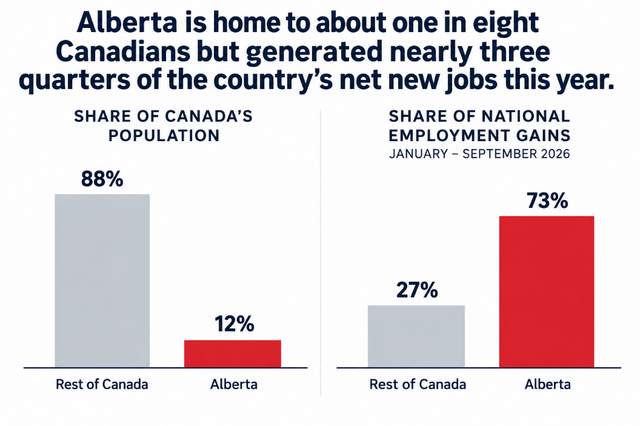
Alberta is generating a disproportionate share of Canada’s new jobs. Smaller provinces like Prince Edward Island can look impressive on percentage charts because of their small populations. Among provinces with over a million people, Alberta’s job growth rate is roughly three and a half times Saskatchewan’s. Quebec and Ontario have posted net losses so far in 2026.
From January to September, Alberta accounted for 73% of national employment gains, while making up about 12% of the country’s population.
ATB Economics, “National employment slips, Alberta gains” (Oct 9, 2026): Alberta accounted for 73% of national employment gains over the first three quarters of 2026, with employment up 3.5% vs 0.6% nationally: ATB Financial.
Importantly, this growth is not just oil and gas. Alberta lost about 10,000 oil and gas jobs in 2025 and still led the country in job creation. That points to a genuinely diversifying economy.
Layne expects interprovincial migration to pick up again, this time driven more by employment than affordability. Younger people in regions facing plant closures and weaker job prospects may look to Alberta, where they can still afford housing and build a career. He also noted mortgage delinquencies have risen sharply in Ontario while remaining very low in Alberta.
A More Diversified Economy
Several sectors are fuelling growth beyond energy:
- Logistics: Calgary has a major international airport surrounded by land available for warehousing, unlike Vancouver, where space is scarce and expensive. Logistics was the one part of Calgary’s economy that kept growing through the last downturn.
- Aerospace and manufacturing: new investment is arriving in sectors Alberta barely had before, helped by a business-friendly regulatory environment.
- Office space: Calgary’s large supply of vacant office space keeps commercial costs low for companies relocating here.
- Data centres: Alberta’s deregulated electricity market and natural gas supply make it attractive for large data centre projects. Fibre optic lines move the data, so the facilities do not need to sit near the end user.
- Tech: Calgary has posted the fastest tech talent growth in North America for the third year in a row.
- Agribusiness and defence: agribusiness is a growing multibillion-dollar sector, and new federal defence spending could benefit sites like Cold Lake.
CBRE 2026 Scoring Tech Talent report: Calgary’s tech workforce grew 56% between 2022 and 2025, the highest growth rate among 50 North American markets, for the third consecutive year: Calgary Economic Development.
Specific data centre figures (“$13 billion for Meta,” “$10 billion near Olds“) and “38,000 new jobs from future military work” attributed to Premier Danielle Smith are unverified. Add sources or remove the figures.
Energy Investment on a Scale We Have Not Seen in Years
On top of the diversified growth, energy investment is returning in a big way. Layne walked through several proposed pipeline and capacity projects, including a new West Coast pipeline, a line to the U.S., and optimizations of existing systems. Combined, they could add roughly 2.1 million barrels per day of export capacity, about half of what Alberta currently produces.
Including the oil sands expansion needed to fill those pipelines, plus LNG, total investment could fall somewhere between $245 billion and $330 billion over roughly a decade. For scale, a world-class hospital costs about $1 billion.
Layne made an important point about where this money comes from. When a province sells resources to the rest of the world, it brings in new money that circulates through the local economy many times. That is different from government spending, which is funded by taxpayers already in the economy.
Velocity of money is how often a dollar changes hands in an economy over a period of time. New outside money that is spent and re-spent locally creates more economic activity than the original amount alone.
He expects these projects to move forward for several reasons: broad support across major federal parties and most provinces, the federal government co-funding at least one project, global investors seeking stable jurisdictions given instability in the Middle East, and existing infrastructure and expertise. The biggest hurdle is skilled labour: engineers, tradespeople, and finance professionals. That likely means more people moving to Alberta.
The timeline matters, though. Engineering and planning take a year or two, construction three to four years, and full operations five to seven. This supports the medium- and long-term outlook. It will not erase today’s rental inventory overnight.
Inflation and Real Estate
Layne also expects inflation to stay elevated over the long run, with money supply continuing to grow. For real estate investors, that has a specific effect: property values and rents tend to rise with inflation over time, while the mortgage balance used to buy the property stays fixed in dollar terms. In real terms, the debt shrinks. He also believes high debt levels make a return to the extreme interest rates of the 1980s unlikely.
Why a Downturn Can Be the Best Time to Buy Good Properties
Timing the market is very hard. Consider the properties above. If they had been listed three years ago, investors would have been more excited, there might have been competing offers, and they likely would have sold for more. Today, the same houses are listed for less and sitting without competing offers. The houses did not change. Only the market mood did.
Layne recommends viewing real estate as a 20 to 25 year investment. Over that horizon, what matters most is owning genuinely good properties.
“If you’re flipping properties, the price is the only thing that matters. If you’re building a portfolio, the property type is what matters the most, not the timing of the market.” – Layne Walers 00:36:31
Layne’s Worst-Timed Purchase Became His Best Property
Layne’s worst purchase from a timing perspective was in 2007, right at the peak of a strong Alberta bull market. The market did nothing for him for roughly 15 years, and adjusted for inflation, he lost market value.
Yet it is still his best property. It is a three bedroom up, two bedroom down home on a corner lot with south-facing windows and deck, across from a park, with plenty of parking and both an oversized double garage and an oversized single garage. It has always been easy to rent and cash flows well. As he put it, if he had 18 of those properties, he would be retired, despite buying at the worst possible time.
The lesson: if you buy a great property for $250,000 and it is worth $600,000 in 25 years, it barely matters whether you paid $259,000. In a downturn, those great properties (corner lots, room for a large garage, legal suite potential) are easier to find, easier to inspect properly, and cheaper than they were a few years ago. Waiting for the recovery usually means buying back into competing offers.
Proceed With Caution: How to Protect Yourself Right Now
None of this means ignoring the risks. Inventory is high, cash flow is tight, and rents may fall further.
“I always kind of stress test my portfolio at about a 30% drop in rents, which is insane. But I need to make sure I can make it through a couple of years with that.” – Layne Walters 01:07:30
Layne believes rents are roughly halfway through that kind of decline from the peak, with perhaps another 10% to 15% to go, although rent drops have slowed recently. Edmonton may take longer to correct, since it builds more large 40-plus unit buildings that take up to four years to complete, compared to Calgary’s eight-plexes at 18 months to two years.
Practical steps:
- Stress test your numbers for higher rates and lower rents before you buy.
- Keep a cushion of cash or cash flow from other properties.
- Do not buy negative cash flow properties expecting rents to rebound soon.
- Focus on value-add: legal suites, rentable garages, and tenant-paid utilities.
Single-Family vs. Multi-Family: Not All Properties React the Same
Anthony raised an important distinction. Single-family home values (detached and, to an extent, semi-detached) are driven mainly by buyer demand and housing supply, not rents. If rents fall, your cash flow may suffer, but your property value likely will not drop to the same degree.
Multi-family is different. A 10-plex is valued based on the income it produces, so falling rents hit its valuation more directly. That calls for a bigger buffer right now.
NOI (net operating income) is a property’s annual rental income minus operating expenses, before mortgage payments. Cap rate (capitalization rate) is NOI divided by property value. Multi-family buildings are typically valued by dividing NOI by the market cap rate, so lower rents mean lower NOI and a lower value.
Unit type matters too. Small basement suites, including tiny one-bedroom suites of about 300 to 400 square feet, have seen the biggest rent drops. Larger main-floor units with a yard have held up much better. Older homes compete with brand-new eight-plexes on finishes, but they can win on space. As Layne pointed out, a tenant with a dog will value a backyard they can open the door to at 3 a.m. in minus 25 weather.
Final Thoughts
Calgary’s market is in an adjustment phase. Condos and townhouses face the most pressure, rents are softening, and vacancy will likely rise further before supply is absorbed. At the same time, Alberta’s job growth, economic diversification, and planned investment give us real confidence in the medium- and long-term outlook.
For investors, this is not a time to stretch. It is a time to be selective, run conservative numbers, and focus on properties with strong long-term fundamentals. If you want a second opinion on whether a property is a good fit for a value-add strategy, reach out to us. We are happy to review the numbers with you.
FAQ
If I spend $50,000 to $100,000 on improvements to boost cash flow, how long does it take to earn that back?
It can take many years to recover the cost of improvements through cash flow alone, especially since the cost is often added to an amortized mortgage. The bigger question is whether the improvement adds enough value and resilience to justify it. If a property’s realistic maximum market value will not support the added investment, the improvement probably is not worth it. That is why this strategy works on the right property, not every property.
Can I finance renovations or a garage as part of my mortgage?
Yes, a “purchase plus improvements” mortgage can roll renovation costs into the financing. However, you typically still need to fund the work up front, through cash or a line of credit, and the lender releases the improvement funds after the work is completed. The lender will also assess the property’s value with and without the planned renovations.
Purchase plus improvements is a mortgage that adds the cost of planned renovations to the purchase price, with the renovation funds held back until the work is done and verified.
Do garage rentals meet the 1% rule?
An audience member pointed out that a $40,000 garage earning $400 per month returns about 1% of its cost monthly, which is a strong return. The 1% rule is very hard to hit on whole properties in Calgary, but garages can come close. Garages also hold up well because they need very little maintenance and have low turnover.
The 1% rule is a quick screening guideline suggesting monthly rent should equal at least 1% of the purchase price (or, here, the cost of the improvement).
Do the migration numbers account for people leaving Alberta?
Yes. The migration figures are net numbers, so they already subtract people leaving the province. The gap between earlier population forecasts and actual results came largely from non-permanent residents who were expected to leave but did not.
With MLI Select, are rent increases capped on the affordable units?
Yes. To qualify through affordability, you commit to keeping the designated units at or below the affordable rent level for a minimum of 10 years. This is not tied to your mortgage term. Rents on those units can increase, but increases are capped by CPI (Consumer Price Index) inflation. Layne noted that CPI often runs below the real cost increases investors experience, which can limit returns if inflation stays high.
CPI (Consumer Price Index) is Statistics Canada’s main measure of inflation, tracking price changes in a basket of common goods and services.
CMHC confirms affordability criteria apply for a minimum of 10 years: CMHC MLI Select. Reviewer: verify the CPI cap wording against current CMHC guidelines.
What happens to the affordability commitment if I sell an MLI Select property?
The 10-year commitment continues and does not reset. Based on the discussion, it is tied to the mortgage, through an assignment of rents, rather than registered on title. Getting out is difficult. A buyer generally must qualify to assume the mortgage, including the personal guarantee, and lenders are reluctant to approve this. Brokers have also reported that discharging early may require paying the remaining interest for the term, which can be expensive. Because the product is still relatively new, there are not many real-world examples yet.
Does the affordability requirement follow the unit or the tenant?
The unit. If you designate two units in an eight-plex as affordable, those units must stay affordable for the full 10 years. If a tenant moves out, the new tenant’s rent must still fall within the allowed maximum.