
Layne is a Co-Host of the Calgary REI Hub Meetup, Real Estate Investor, and Mortgage Broker at Your Mortgage Team
Key Takeaways
- Running an Airbnb is closer to a part-time job than a passive investment — self-managing means showing up regularly to clean, restock, and turn over the unit.
- Hiring a short-term rental management company eliminates the hands-on work, but also eats into returns — often bringing net income close to what a long-term rental would produce anyway.
- Market forces tend to flatten Airbnb’s profit advantage over time: when returns are good, more investors enter, supply increases, and nightly rates fall.
- Calgary requires a business licence to legally operate a short-term rental — operating without one creates real risk, including being blocked from listing on platforms like Airbnb.
- Startup costs (furniture, licensing, compliance) can run $15,000–$40,000+, which is a meaningful barrier to entry.
- Certain properties — walkable, trendy, visually interesting — are genuinely better suited to short-term rentals than others.
- If you build a strategy around Airbnb income, make sure the property also works as a viable long-term rental. If short-term rental income dries up, you don’t want to be stuck in a negative cash flow position.
Is Airbnb a Smart Investment Strategy in Calgary?
Short-term rentals get a lot of attention from real estate investors. The appeal makes sense: higher nightly rates, flexibility, and the possibility of earning significantly more than a traditional long-term tenant would pay. But for every investor making good money on Airbnb, there are others who’ve overextended, underestimated the workload, or found themselves stuck with a property that doesn’t pencil out once the short-term income disappears.
I get asked about this a lot — whether my clients are making good money with Airbnb rentals, and whether it’s a strategy worth pursuing in Calgary. Here’s my honest take on where short-term rentals work, where they don’t, and what to watch for before you go down that road.
Running an Airbnb Is Not Passive Income
Let’s start here, because it’s the part people tend to underestimate. Managing a short-term rental yourself means showing up regularly — changing sheets, doing laundry, cleaning the unit, restocking supplies, handling guest communication. If you’re turning a unit over a couple of times a week, that’s a meaningful time commitment when you factor in drive time and the actual work.
In a lot of ways, it functions more like a part-time job than a passive investment. Yes, you’re going to make more money than a long-term rental — but you’re also working more hours to get there. When you look at it that way, the extra income starts to look a lot less impressive.
“My personal opinion on it is it’s actually just a part-time job because what you actually have to do is you just have to work a lot harder. You have to go there, show up, change sheets, do laundry, clean the place… and that’s basically just a part-time job.”
What About Hiring a Property Manager?
The obvious workaround is to hire a short-term rental management company to handle everything for you. And yes, those companies exist — but they’re doing the work in exchange for a cut of your revenue.
Here’s the thing: if hiring a management company and still coming out way ahead was easy and reliable, everyone would do it. And the moment everyone does it, more supply enters the market, nightly rates come down, and the profit advantage shrinks. That’s just how markets work.
Once you account for management fees on top of the usual operating costs, many investors find that their net returns are roughly in line with what they’d earn from a traditional long-term rental — with more complexity and more moving parts.

Market Forces Will Flatten the Profit Premium
Short-term rental returns are market-driven. When a strategy works well for long enough, more investors pile in, supply grows, and prices adjust. This is true for any investment category, and it’s especially true for Airbnb.
There are exceptions — properties with unique characteristics, great locations, or specific access constraints — but as a general rule, I don’t think you’ll ever see a sustained, excessive profit advantage over long-term rentals for the average investment property. The market will find its equilibrium.
The takeaway: even if short-term rental income is strong right now in a particular area or property type, build your strategy assuming it might not stay that way.
Calgary Regulations and the Real Costs of Getting Started
Business Licence Requirements
City of Calgary – Short-Term Rental Business Licence: Rules and Regulations
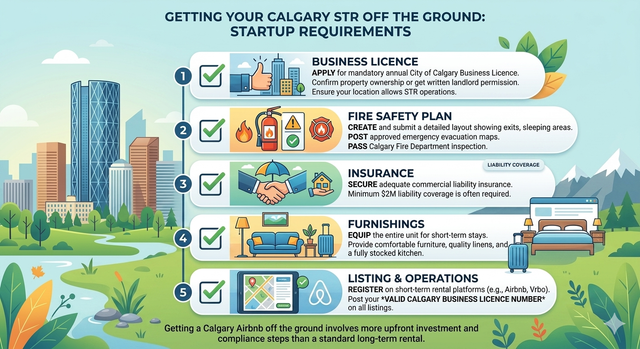
Operating a short-term rental in Calgary without a business licence isn’t just a minor oversight — it creates real risk. Platforms like Airbnb have increasingly made it difficult to list properties without a valid licence number, and the City has enforcement mechanisms in place. As of April 1, 2025, Calgary updated its short-term rental bylaws, and all hosts — whether renting out a primary or non-primary residence — are required to hold a current business licence.
Short-Term Rental (STR): As defined by the City of Calgary (effective April 1, 2025), a short-term rental is the business of providing temporary accommodation for compensation in a dwelling unit or portion of a dwelling unit for periods of up to 180 consecutive days, listed through a short-term rental platform.
Startup Costs
Beyond licensing, there are real upfront costs to getting an Airbnb-ready unit set up properly. You can’t furnish it with mismatched items you’ve pulled out of storage — guests have expectations, and how a listing looks in photos directly affects your booking rate. Depending on the unit and how frugally you approach it, you’re looking at somewhere in the range of $15,000 to $40,000+ to get the property guest-ready.
That’s a significant upfront investment on top of your down payment and closing costs. And it’s money you’ve spent before you’ve booked a single guest.
- Business licence fees (primary vs. non-primary residence rates apply)
- Fire safety plan and inspection
- Liability insurance (minimum $2 million coverage required)
- Furniture and furnishings ($15,000–$40,000+ depending on unit size and quality)
- Ongoing platform fees, cleaning costs, and consumables
Condo Restrictions
It’s also worth noting that many condo buildings in Calgary prohibit short-term rentals entirely through their condo bylaws. Before purchasing any condo as a potential Airbnb, you need to verify what the condo board allows — this isn’t a technicality you can work around after the fact.
Which Properties Actually Work Well as Short-Term Rentals?
Not all properties are created equal when it comes to short-term rental performance. Some types of properties genuinely do outperform as Airbnbs — and some don’t. Here’s how I’d think about it:
Properties With Strong Short-Term Rental Potential
- Walkable, trendy neighbourhoods: Areas close to the downtown core, convention centres, event venues, or popular dining and entertainment districts tend to attract consistent short-term guests.
- Visually distinctive properties: Character homes, loft-style units, heritage buildings — properties with personality that photograph well and stand out in a listing.
- Properties you already own or live in: House hacking scenarios (renting part of a duplex you own, or a suite in your primary residence) can be a very effective entry point, where the short-term premium is a bonus rather than the whole strategy.
House Hacking: A strategy where an investor lives in one unit of a multi-unit property (or one part of a home) and rents out the other unit(s) to offset mortgage and carrying costs.
Where to Be Cautious
The properties that perform best as short-term rentals are often not the same properties that make the strongest long-term rentals — and that matters. If you’re paying a premium for a trendy character property because you’re banking on Airbnb income, you need to understand that the same property might not generate the same rent from a long-term tenant. If short-term rental income declines or the regulatory environment tightens further, you could end up in a negative cash flow position that’s hard to get out of.
“Don’t go into purchasing a property like that necessarily if you’re dependent on extra Airbnb income because that might not get you the same extra rent as a long-term rental.”
How to Think About Short-Term Rentals as an Investment Strategy
Short-term rentals aren’t a bad idea across the board — plenty of investors make them work well, including as part of a broader portfolio alongside long-term rentals. But I’d encourage you to think through a few things before committing:
- Does the property also work as a long-term rental? This is the most important question. If short-term rental income disappears, can you still service the mortgage and generate acceptable cash flow on long-term tenants? If the answer is no, that’s a real risk to carry.
- What stage of your investing career are you at? Short-term rentals can make sense in certain contexts — especially early on, if you’re house hacking or building equity in a property you’re already living in. They’re harder to justify as a core portfolio strategy at scale.
- Do you have the time? Self-managing is work. If you’re hiring it out, model the numbers honestly — does the strategy still make sense after management fees?
- Have you accounted for the upfront investment? Furnishings, licensing, compliance, and inspections add up. Make sure your projections include realistic startup costs.
- Are you prepared for regulatory changes? Calgary’s short-term rental rules have evolved meaningfully in recent years and will likely continue to evolve. Factor in legislative risk when building your projections.
“I would make sure that if you’re doing it as an actual investment strategy that you do so keeping in mind that the strategy may stop working and that that property is something that you can at least turn into a good long-term rental.”
The Bottom Line
Whether Airbnb is a good investment really does depend — on the property, the person, the time available, and where you are in your investing journey. There are people who’ve lost money, people who’ve made mistakes, people who’ve overextended, and people who’ve built a solid income stream doing it well.
Go in with clear eyes. Model the numbers honestly. Make sure your exit works if the strategy changes. And if you’ve had experience — good or bad — with short-term rentals in Calgary, I’d genuinely like to hear about it in the comments below.