Key Takeaways
- Calgary’s resale market for detached and semi-detached homes is in balanced territory, but apartments and townhouses have seen meaningful price drops and higher inventory levels.
- Rental prices are down across most property types — but the drop is not equal. Apartments and basement suites have fallen the hardest; main floor units are showing early signs of stabilization.
- For single-family and small multifamily landlords, staying vacant to protect your listed rent almost always costs more than adjusting to market and getting it rented quickly.
- Cash flow protection during a downturn comes from reducing expenses, increasing effective rent without necessarily raising listed rent, and retaining good tenants.
- Renovating now — not during the boom — is the right move. In a soft market, property condition matters more than price when competing for quality tenants.
- Location still matters. Certain Calgary neighbourhoods and property types are proving more resilient than others.
- A combination of densification math, population growth, and economic fundamentals suggests the downturn may not be as severe or prolonged as initially feared.
- Alberta’s long-term economic story — job growth, fiscal health, business environment — remains one of the strongest in the country.
Where the Calgary Market Stands Right Now
Before we get into how to navigate a softer rental market, it helps to understand what’s actually going on in the broader Calgary real estate landscape. The picture is nuanced — and it depends heavily on what type of property you’re looking at.
Resale Market: Detached and Semi-Detached
For detached and semi-detached homes, Calgary is sitting in balanced market conditions across most of the city. Months of supply for detached homes is around 2.45, and semi-detached is at approximately 2.73 — both solidly in balanced territory. Year-over-year prices are slightly down, but we’re talking under one percent for semi-detached. It’s mostly stable, with the steeper drops concentrated on the east side of the city. The west side has held up better.
Apartments and Townhouses: A Different Story
Apartments and townhouses are a different story. These segments have seen fairly substantial year-over-year price drops, and months of inventory for apartments has climbed to around 5.14 — that’s a buyer’s market. Townhouses aren’t as severe, but they’re softer than detached. If you’re an investor with exposure to condos or apartment-style units, you’re feeling this more acutely than someone holding single-family properties.
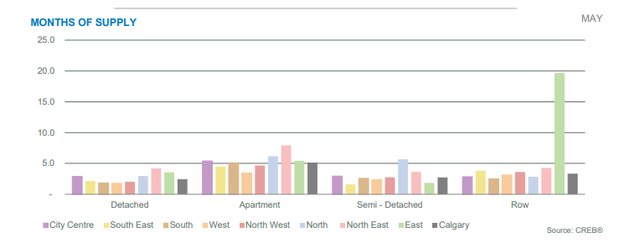
Credit: Calgary Real Estate Board May 2026 Market Report
What’s Happening in the Rental Market
Rent Is Down — But Not Equally
On the rental side, data from Yardi (property management software/data platform) tracking larger multifamily operators shows year-over-year in-place rent growth is actually slightly negative, sitting just under -2%. That said, there’s an important nuance: many larger operators hadn’t yet reached peak rents with their existing tenants — they tend to raise rents slowly over time — so the in-place rent decline looks smaller than what you’d see in the lease-over-lease numbers.
When a unit turns over and a new tenant comes in, the rent reset is more pronounced. That’s where you see Calgary’s actual market rent drop more clearly. And because Alberta doesn’t have rent control, landlords here have both more flexibility and more exposure in both directions.
Compared to other cities, Calgary saw the largest rent drop in the country among the markets tracked. The comparison to Toronto and Montreal is instructive: rent-controlled markets like Montreal saw smaller drops because rents were already suppressed, while Toronto — despite having rent control for many buildings — is still catching up on gap. Calgary had no such cushion, which partly explains the larger swing.
Vacancy Is Up — and What That Really Means
Calgary’s vacancy rate in the multifamily space is higher than other western Canadian markets, and higher than it used to be. Part of that is deliberate: larger operators sometimes choose to absorb vacancy rather than drop rents, because their building’s value is tied directly to net operating income. Drop the rent, and you drop the appraised value. So some of the elevated vacancy is a strategic choice, not purely a demand problem.
That said, the elevated vacancy is also real — it reflects an oversupply situation that’s been building for a few years.
Not All Property Types Are Equal
Data tracked daily by Larry Lee, who is a commercial mortgage broker with Canada ICI on Rent Faster shows that the rental market drop is not uniform across property types:
- Apartments and condos: Hardest hit. Significant rent declines and high inventory.
- Basement suites: Also large drops. Supply has expanded rapidly through secondary suite construction.
- Main floor units: Starting to show early signs of stabilization and even slight upticks.
- Full house rentals (single family): Relatively stable. Not much new single-family supply has been added to the rental market.
Your individual investor story is not the same as the headlines. If you hold single-family or main floor rentals, your situation is meaningfully different from someone holding apartment condo units or basement suites in high-density areas.
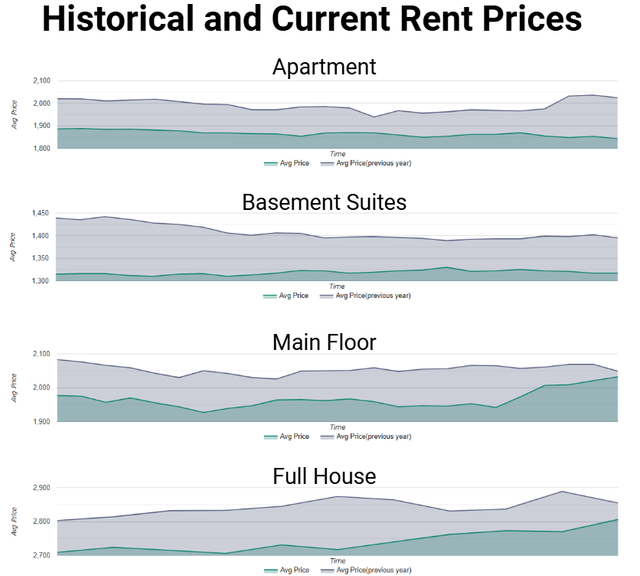
Credit: Rentfaster.ca
Should You Drop the Rent?
You’ve probably heard the advice: never drop the rent. We want to push back on that — because like most broad rules, it’s not that simple.
If You Own Large Multifamily (5+ Units, Especially 20+)
For larger multifamily operators, building value is directly tied to NOI (Net Operating Income): The total rental income generated by a property minus operating expenses, before debt service. For commercial real estate, a property’s appraised value is typically calculated as NOI divided by the capitalization rate (cap rate). If you drop rents, you’re also dropping your building’s value. At a 5x cap rate, a $100/month rent drop on a unit represents roughly $1,200 annually — and $6,000 of building value per unit. Multiply that across 50 or 100 units and it becomes very significant very fast.
There’s also a cascading effect: if you drop rents on vacant units, existing tenants at higher rents find out and start asking for the same treatment. So some larger operators strategically maintain higher rents and accept some vacancy rather than repricing the whole building. That calculus can make sense — especially if they believe the softness is temporary. If you’re in a rent-controlled market, that adds another layer of complexity: you can only raise rents back so much per year once you’ve dropped them.
If You Own Single Family or Small Multifamily in Alberta
For the vast majority of smaller Alberta landlords, the math usually points the other way. You’re not setting comparables for an entire building. Your tenants don’t know each other. And if you’re sitting vacant for months trying to hold a rent number, you’re losing real money every day.
Consider this scenario: you list at $2,300/month. After 45 days vacant, you finally negotiate down to $2,150. Compare that to listing at $2,150 from day one and renting it in five days with no vacancy gap. Even though you’re collecting $150 less per month in the second scenario, you’re almost certainly ahead on the 12-month lease because you’re not eating a month or more of zero income.
“I’ve seen some people say there were like 7 or 8 months vacant. You will never get that back. Never. You need to adjust to market and get it rented.” – Anthony Therrien-Bernard
And that doesn’t account for the hidden costs: your time, fuel for showings, communication. Thirty showings trying to get $2,300 versus two showings at $2,150 is a real trade-off that rarely gets factored in. Because Alberta has no rent control, if the market recovers, you can raise rents back up anyway.
How to Protect Your Cash Flow Right Now
Whether or not you decide to adjust rents, there are concrete things you can do today to protect your bottom line.
1. Appeal Your Property Taxes
This year, property tax assessments were across the board in Calgary — and many landlords received significant increases. Your assessed value should reflect actual comparable sales in your area. If it doesn’t, you have grounds to appeal. We’re happy to pull comparables for you if you want to check whether your assessment is in line. A lower assessment means a lower tax bill, which directly improves cash flow.
2. Shop Your Insurance
Insurance costs have climbed substantially in recent years, largely due to hail damage claims. If you own commercial or multifamily property, the increases have been even more pronounced than on residential. Shop around — this is not a set-it-and-forget-it expense right now.
3. Audit Your Utilities
For multifamily owners, utility expenses are directly tied to NOI. Simple things matter here: fix leaky toilets, do quarterly unit inspections, make sure tenants are reporting maintenance issues. A running toilet in a central water-metered building can cost thousands of dollars annually — and tenants often don’t report it because they’re not paying the water bill. Weatherstripping is another one. Small fixes, real savings.
4. Increase Effective Rent Without Raising Listed Rent
Effective rent is the actual per-month income you’re generating when you factor in all costs and concessions. There are a few ways to improve it:
- Offload utilities to tenants: If you’re currently covering utilities, renegotiate this at lease renewal — even if it means slightly lowering the listed rent, the net effect on your bottom line may be positive.
- Rent garages separately: A detached garage, especially in a hail-prone city like Calgary, can command consistent income. Contractors, people with trailers, or anyone with a nice car will pay for covered parking. Turnover is low.
- Storage and parking: If you have extra space, monetize it.
- Add a basement suite: If you haven’t already and your property allows it, a legal suite adds meaningful income.
- Room rentals or furnished units: Higher yield per square foot, depending on your market and risk tolerance.
Note on offering Wi-Fi: Some landlords offer included internet as a tenant retention tool. It can work, especially in larger buildings. Just know that you’ll become your tenants’ tech support. That’s a real time cost to factor in.
How to Keep the Good Tenants You Already Have
Vacancy is expensive. A quality tenant who renews is worth more than you might think — not just because of the avoided vacancy gap, but because of the reduced showing time, cleaning, and stress. Here’s how to improve your renewal rate:
Offer Small Incentives at Renewal
- A professional cleaning as a renewal bonus — low cost, high perceived value.
- Minor property upgrades: a smart thermostat, a new faucet, fresh paint in a tired room. You don’t have to buy new — marketplace finds work fine.
- Holiday gift cards or a bottle of wine. Small gesture, real relationship signal. And yes, it’s a tax-deductible business expense.
Maintain the Relationship
Your tenants are your customers. They’re the ones paying down your mortgage and building your net worth. Treat the relationship accordingly. A good landlord who responds quickly, fixes things promptly, and treats tenants with respect will have better retention than one who doesn’t — regardless of what’s happening in the rental market.
Start the Renewal Conversation Early
Don’t wait until 30 days before the lease ends to find out what your tenant is planning. Start checking in around 90 days out. Ask if they’re still planning to stay, whether their situation is changing, what their intentions are. That gives you enough runway to either lock in a renewal or start marketing the unit before you’re in a vacancy crunch.
How to Re-Rent Faster When You Do Have Vacancy
Price to Market — Not to Your Mortgage
This one comes up constantly. Your mortgage payment, condo fees, or carrying costs have nothing to do with what the market will bear in rent. If a townhouse rents for $1,800/month but your all-in costs are $2,300, you have a cash flow problem — but the solution is not to list at $2,300 and sit vacant. Understand your market rent, price accordingly, and work the other levers (refinancing, suite income, expense reduction) to improve the position.
List Before the Unit Is Vacant
In Alberta, you can conduct showings within the last 30 days of a fixed-term lease. Take advantage of that. Get it listed early, generate interest, and be ready to start showings the moment you’re legally able. Don’t wait until the unit is empty and you’re already losing income.
Be Responsive and Make Showings Easy
Tenants have options right now. If you’re slow to respond or hard to schedule, they’ll move on. Consider using a free scheduling tool like Calendly to let prospective tenants self-book showings during windows that work for you. It reduces back-and-forth, sends automated reminders, and makes you look professional without adding much to your workload.
Make the Listing Stand Out
- Professional photos. Most listings on Rent Faster are taken with a phone, lights blazing, blurry and uninviting. Good photos are a competitive advantage — and you can reuse them for years.
- A 3D tour for apartments and larger units can be worth the investment.
- Make sure the unit is clean and presentable for every showing. First impressions are make-or-break when tenants have choices.
- List on all relevant platforms: Rent Faster and Facebook Marketplace are the primary ones in Calgary. Rental.ca is another option, though tenant quality can vary.
Use Incentives Strategically
If you offer a “free month,” put it at the back end of the lease — the 12th month, not the first. The last thing you want is a tenant taking the first month free and then leaving. Also, be clear on what your effective rent actually is. A $2,000/month unit with a free month works out to $1,833/month annualized. A $1,850/month unit with no incentives is actually more expensive for the tenant. Don’t confuse listed rent with effective rent — and make sure you’re comparing apples to apples when sizing up your competition.
Consider Lease Timing
Calgary rents fluctuate seasonally by as much as 5% between peak (June–September) and trough (December–April). If you end up with a vacancy in November or December, consider signing a shorter lease timed to end in spring. That way your next re-rental hits the stronger leasing season.
Be Pet-Friendly If You Can
Pet owners are generally longer-tenancy renters because it’s harder for them to find places that accept animals. If your property and insurance allow it, being pet-friendly can meaningfully reduce vacancy and turnover.
Upgrade the Unit — Now
Here’s the counterintuitive one: when rents are dropping, property condition matters more, not less.
“When rents go down, the property condition matters more than anything. A lot of people want to cheap out — it’s the exact opposite of what you should be doing.” – Layne Walters
When the market was tight, tenants would rent whatever was available. Now they have choices. A tenant looking at basement suites for $1,300/month isn’t going to be swayed by an extra $50 off a dated unit when there’s a clean, renovated one nearby for the same price. The price is already coming down — so now what differentiates you is quality. New countertops, updated cabinets, ensuite laundry, a dishwasher, proper lighting — these things matter now in a way they didn’t during the boom.
The renovation you’ve been putting off? Now is the time. Contractors are a little less busy. And the photos and condition improvements you make today will carry you through the next several years of leasing cycles.
How Location Affects Your Rental Exposure
Location has always mattered in real estate, but in a downturn it becomes more pronounced. Some Calgary neighbourhoods and property types are holding up much better than others.
More Resilient Areas
- Near post-secondary institutions (University of Calgary, Mount Royal University)
- Near major employment anchors (Foothills Hospital, South Health Campus, airport corridor)
- More established, inner-to-mid-city neighbourhoods with lower turnover — areas like Huntington and Barrington, where you’re not competing against a glut of new builds and the tenant base tends to be stable blue-collar or airport-adjacent workers
Higher Exposure Areas
- Seton: Almost every house was built with a basement suite and side entrance. That supply concentration is hitting hard.
“At the peak of the market we were seeing one-bedroom basements renting for $1,700, $1,800. And Seton was — builders were calling it the second downtown of Calgary. Now rents have dropped all the way to $1,100.” – Santhosh Nathan
- Areas with large concentrations of purpose-built apartment buildings offering incentives (free month, free gym, etc.) — though these tend to compete more with other apartments than with single-family or small multifamily product
- Downtown condo units that were originally marketed for short-term rental but shifted to long-term after bylaw changes — these added inventory to the market suddenly
Know Your Competition
Understand what you’re actually competing against. If you have a main floor unit or a three-bedroom single-family rental, you’re not really competing with a one-bedroom apartment in a new purpose-built tower, even if they’re in the same neighbourhood. The tenant profile is different. Know who your prospective tenant is and what else they’re looking at — then make sure your listing wins that comparison.
Is This a Good Time to Buy?
As Warren Buffett puts it: be fearful when others are greedy, and greedy when others are fearful. Downturns create buying opportunities that don’t exist in hot markets.
Right now, you can actually put conditions on offers. You can take time to properly run the numbers. You have negotiating room. Those things weren’t available even two years ago when offers were flying in over asking with no conditions.
There’s also an important risk argument for buying in a downturn: if a property cash flows today at current — suppressed — rents, you have built-in cushion. If rents recover, your cash flow improves. If they hold flat or drop a bit more, you’ve already stress-tested the deal at the bottom. That’s a more defensible position than buying at peak rents and hoping they hold.
The Bigger Picture: Why We’re Still Bullish on Alberta Long-Term
Short-term, the rental market is soft. We’ve covered that in detail. But here’s the broader context that matters for anyone making long-term investment decisions.
The Densification Math People Are Missing
When you read headlines about 20,000+ units under construction in Calgary, it’s easy to panic. But the net unit addition is not the same as the gross number being reported.
When you build a new infill eight-plex in an established neighbourhood, you first tear down a bungalow that likely had a basement suite — so you’re removing two units before you add eight. The net addition is six, not eight. And half of those new units might be small one-bedroom basement suites under 500 square feet. In terms of actual bedroom capacity added to the city, the number is meaningfully lower than the headlines suggest.
This is very different from the greenfield development model of the last 20 years, where builders were building on farmer’s fields and adding entirely new units to the city’s supply. Inner-city densification is denser per lot — but it’s replacing existing units, not purely adding new ones. When you account for that displacement, the supply pressure is not as severe as it looks on paper.
Alberta’s Economy Is Doing the Heavy Lifting for the Country
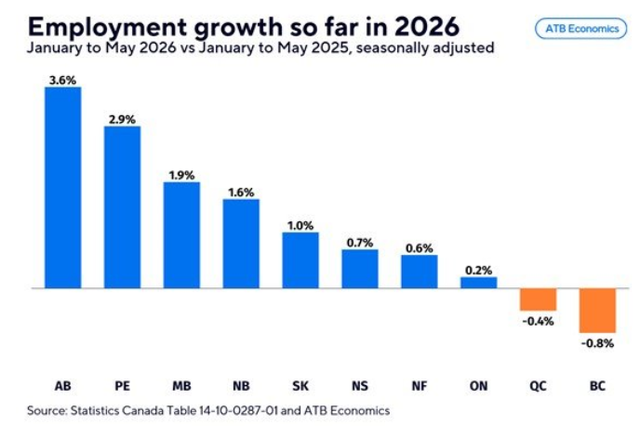
- Alberta led Canada in job growth last year — and that growth happened even while the province lost 10,000 oil and gas jobs. The diversification story is real.
- Alberta’s provincial deficit, which was projected at nearly $10 billion earlier this year, has effectively been eliminated.
- Alberta is ranked among the top 25 fastest-growing millionaire hubs in the world over the last decade.
- Businesses are relocating here from across Canada and internationally. The tax environment, regulatory framework, and cost of doing business are all competitive advantages.
- Oil and gas investment is coming back — and once projects are developed in Alberta, they’re more secure than equivalent projects in less stable geographies. That premium is increasingly being priced in.
Long term — five to ten years — Alberta’s fundamentals are as strong as anywhere in the country. If you can survive the short-term soft rental market, the long-term thesis is intact.
What the Data Is Actually Saying About the Bottom
Here’s some genuine good news, or at least less-bad news: there are early signals that Calgary’s rental market may be closer to stabilizing than it looked even a few months ago.
Rent Faster data is showing a slight drop in total rental listings for the first time in three years. That’s a positive leading indicator — fewer units sitting on the market means demand is absorbing supply. Main floor unit rents have plateaued and are showing small upticks. And the densification math discussed above means the effective new supply hitting the market over the next few years is lower than the headline construction numbers suggest.
The anecdotal evidence is lining up too. Lease renewals that were all downward pressure a year ago are starting to hold flat or even nudge up in some cases. Tenants who are leaving are being replaced at similar or slightly higher rents in select property types and neighbourhoods.
This doesn’t mean rents are going up anytime soon. We’re still in a soft market and you should plan accordingly. But the case for a catastrophic, prolonged, 20%-off-from-here scenario looks less likely than it did even a few months ago. The floor appears to be forming.
FAQ
Should I ever drop the rent on my rental property?
It depends on your situation. For owners of large multifamily buildings (generally five-plus units, especially 20 or more), dropping the rent also drops your building’s appraised value, since commercial valuations are tied to net operating income. In those cases, accepting some vacancy while holding the rent can make sense, especially if you believe the softness is temporary. For single-family and small multifamily owners in Alberta — where there is no rent control — the math almost always favours adjusting to market rent and minimizing vacancy. A month or more of vacancy will almost always cost you more than a $150/month rent reduction over a 12-month lease.
What’s the best time of year to re-rent a Calgary property?
June through September is the peak leasing season in Calgary. Because there’s no rent control in Alberta, rents fluctuate seasonally — by as much as 5% between the peak summer months and the slower winter period (roughly December through late April). If you have flexibility, time your lease renewals and vacancies to avoid the slow season. If you end up with a mid-winter vacancy, consider a shorter-term lease that ends in spring so your next rental cycle hits the stronger market.
What platforms should I use to list my rental in Calgary?
Rent Faster and Facebook Marketplace are the primary platforms in Calgary. Rental.ca is another option but can attract a more varied tenant pool. Listing on multiple platforms increases exposure. Make sure your listing has professional photos, is priced at market, and is active before the unit actually becomes vacant — in Alberta you can do showings within the last 30 days of a fixed-term lease.
Does property condition really matter that much in a soft market?
More than ever. When rents were rising and vacancy was near zero, tenants didn’t have the luxury of being picky — they took whatever was available. Now they have choices, and they’re using them. A tenant comparing two basement suites at similar rent will choose the one with better finishes, ensuite laundry, a dishwasher, and good curb appeal. Dropping your rent by $50 will not overcome a dated, poorly maintained unit. Invest in the property now — before you lose another month to vacancy.
Is Calgary a good place to invest in real estate right now?
The short-term rental market is soft, and that’s real. But Calgary’s economic fundamentals — job growth, population trends, business environment, fiscal health of the province — are strong. If you’re buying today at suppressed rents and the property cash flows, you’re building in downside protection. If rents recover (and the leading indicators suggest they will, over time), your returns improve. The ability to put conditions on offers, take time to analyze deals, and negotiate — things that weren’t possible in 2022 and 2023 — make this a period where thoughtful buyers can find good entries.
What renovations are worth doing in a soft rental market?
Focus on the things that directly improve tenant experience and listing appeal: updated kitchen finishes (countertops, cabinet hardware, new appliances), ensuite laundry if it’s feasible to add, a dishwasher if the unit doesn’t have one, good lighting, fresh paint, and clean flooring. Smart home upgrades like a keypad lock and smart thermostat are low cost and add perceived value. Curb appeal matters too — a tidy exterior and landscaping signals that the property is well cared for before a tenant even walks in the door.