Key Takeaways
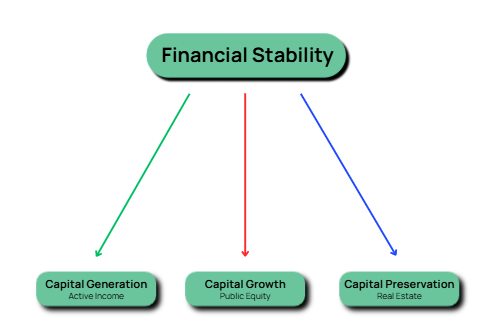
- Guest speaker Dennis Wong, a professional engineer turned full-time investor, breaks wealth-building into three legs: capital generation (active income), capital growth (public equity), and capital preservation (real estate).
- Value investing means finding valuable businesses and paying less than they’re worth, using the same underwriting mindset real estate investors already use on rental properties.
- The stock market is a marketplace, not the investment itself. Wong compares buying a share to buying a piece of a business, the same way buying a rental property means buying a piece of real estate, not “buying realtor.ca.”
- Historical data (M1 money supply, 200 years of asset class returns, and 60 years of Berkshire Hathaway performance) supports staying invested for the long run rather than trying to time markets.
- Day trading and short-term speculation put individual investors up against AI-driven high-frequency trading firms, which Wong argues most people can’t win against consistently.
- Real estate and public equities both fit into a diversified wealth strategy. Each has distinct advantages around leverage, liquidity, and control.
Most of the conversations at Calgary Real Estate Investor Hub focus on property, but building real, durable wealth usually means looking beyond one asset class. At a recent meetup, we welcomed guest speaker Dennis Wong, a professional engineer by background who now invests full-time across both real estate and public equity markets. Dennis walked the group through a framework he calls the “three-legged stool of wealth,” then backed it up with a live, in-person demonstration that made the concept of value investing click for the room. Below, we break down what he shared and why it matters for anyone building a real estate portfolio in Calgary.
The Three-Legged Stool of Wealth
Dennis opened with a simple idea: financial stability rests on three legs, and a stool with fewer than three legs isn’t stable. He explained the framework this way:
- Capital generation — active income from your job, business, or area of expertise. This is the foundation most people build everything else on top of.
- Capital growth — investing for growth, primarily through public equity (stocks). Dennis frames this as owning a piece of a global business, not “playing the stock market.”
- Capital preservation — real estate. Dennis sees real estate primarily as a hard asset that protects wealth, with income generation as a secondary benefit.
He was quick to point out these legs blend together in practice. Short-term rentals, flips, and creative financing strategies, for example, sit closer to active income and business activity than to long-term real estate investing. As Dennis put it, that kind of hands-on value-add work is really “the business of real estate,” distinct from buying and holding an asset for long-term appreciation and income.
What Value Investing Really Means
A large part of Dennis’s talk focused on value investing, an investment approach that involves buying assets (typically stocks) for less than their calculated intrinsic worth, based on analysis of the underlying business rather than short-term price movement. Many people assume value investing means buying cheap, unwanted stocks. Dennis disagreed with that framing entirely.
Instead, he described the stock market as simply a marketplace, no different in principle than a grocery store or an online marketplace. When an investor buys a share, they aren’t “investing in the stock market.” They’re buying a small piece of an actual, operating business. Dennis pointed to the office towers along Calgary’s skyline as an example: most of us will never have the capital to own one of those buildings outright, but the public stock exchange gives ordinary investors access to owning a piece of the global businesses headquartered inside them.
He drew a direct parallel to how real estate investors already think. Underwriting a business, in his view, follows the same fundamental process as underwriting a rental property: understanding the fundamentals (what does the business do, what problem does it solve, what’s the competitive position), then calculating what it’s actually worth before deciding what to pay for it.
The Live $20 Bill Demonstration
“Honestly, that’s value investing at work. You know the value of that $20 bill.” — Dennis Wong
To make the concept tangible, Dennis ran a live demonstration in the room. He held up a $20 bill, a bill whose value everyone in the room already agreed on, and tried to “sell” it for $30, then $50. The room laughed him off. Then he offered it at face value, $20 for $20, and someone took the deal. Finally, he offered the same $20 bill for $10, and hands went up immediately.
The lesson: once you actually know what something is worth, a discount to that value is an obvious decision, and a premium above that value is an obvious pass, even if the asset itself hasn’t changed at all. That gap between price and value, and the cushion it creates, is what Dennis (echoing Benjamin Graham’s original concept) referred to as margin of safety, the difference between an asset’s calculated intrinsic value and the price paid for it, which acts as a buffer against errors in judgment or unforeseen risk.

Why the Market Feels Riskier Than It Is
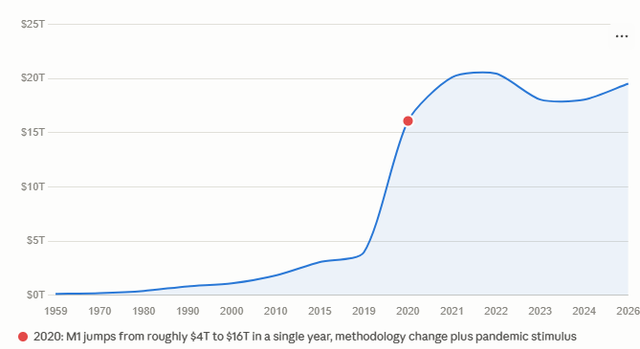
Dennis addressed a common concern directly: stock prices can swing far more sharply than real estate values in the short term. His answer wasn’t to dismiss that risk, but to reframe the time horizon. He shared a chart from the Federal Reserve Bank of St. Louis (FRED) tracking the U.S. M1 money supply, showing that it took roughly 250 years for the total U.S. dollars in circulation to reach $4 trillion, by the year 2000. Between 2020 and 2021 alone, that figure jumped to nearly $22 trillion, largely from pandemic-era monetary policy.
His point: this kind of currency expansion is a major driver of inflation, and it’s part of why holding cash long-term is itself a risk, not a safe harbor. It’s also, in his view, a core argument for owning productive assets, whether real estate or equity in growing businesses, rather than sitting on cash.
200 Years of Asset Class Performance
Dennis also referenced research popularized by Jeremy Siegel, professor of finance at the Wharton School, whose book “Stocks for the Long Run” tracks real (inflation-adjusted) returns across asset classes from 1802 to the present. Siegel’s data shows U.S. equities have delivered an average real return of roughly 6.5–6.8% annually over that period, dramatically outperforming cash, gold, and bonds over the same stretch.
He walked through a more recent chart as well: the S&P 500 over the last 20 years, from 2005 to late 2025, showing roughly 468% total growth, or a compound annual growth rate of about 9.2%, a figure broadly in line with the long-term historical average. Dennis’s larger point wasn’t to promise any specific return, but to show that short-term crashes, including the dot-com bubble and the 2008 financial crisis, appear as brief dips on a 200-year chart, even though they felt catastrophic in the moment.
Trading vs. Investing: Who You’re Really Trading Against
Dennis was direct about the difference between investing and trading. Investing, in his framework, means buying ownership in a business and holding it long enough for that business to actually grow, generate cash flow, and compound in value. Trading, buying and selling within days, weeks, or months, is a different activity entirely.
His argument: because every trade has a buyer and a seller, short-term trading is closer to a zero-sum game than genuine investing. He noted that individual retail investors aren’t just competing against professional fund managers anymore, but increasingly against high-frequency, AI-driven trading systems operated by major financial institutions.
“When you cannot spot a sucker around the table, chances are you’re the sucker.” — Dennis Wong
He also cited long-term S&P 500 data suggesting the market’s real, underlying growth rate is around 10% annually, meaning returns significantly above that in any given year are effectively being transferred from less-informed participants to more disciplined, patient ones.
Getting Started: Index Funds and the Rule of 72
For investors newer to public equities, Dennis recommended starting with a broad index fund, a fund designed to track the performance of a market index like the S&P 500 or NASDAQ, rather than trying to pick individual stocks right away. Even experienced investors, he noted, often hold a mix of index funds alongside a smaller number of individual companies they have high conviction in.
He also introduced the group to the Rule of 72, a quick formula for estimating how many years it takes an investment to double: divide 72 by the annual compound growth rate. At a roughly 10% long-term average return, money doubles approximately every 7.2 years. At a higher growth rate, like the 13–14% Dennis cited for NASDAQ over the last 20 years, that drops to roughly every five to six years.
Finding Above-Average Companies
Rather than picking dozens of individual stocks, Dennis advocated for a highly concentrated approach: roughly 20 individual holdings, plus index fund exposure, focused only on businesses an investor has genuinely researched and has high conviction in holding for 10 to 20 years. He explained that if the S&P 500’s 500 companies average around 10% annual growth, that implies a meaningful number of companies growing well above that average, some in the 12–18% range, and a smaller subset growing even faster.
His advice wasn’t to chase the highest-growth, highest-volatility names, but to look for mature, well-established businesses with predictable, durable competitive advantages, then be patient enough to buy them at a fair price or better.
The Warren Buffett Track Record
To illustrate what disciplined, long-term value investing can look like over decades, Dennis referenced Berkshire Hathaway’s 2024 annual shareholder letter, which reports a compounded annual gain of 19.9% from 1965 to 2024, compared to 10.4% for the S&P 500 (with dividends) over the same period, an overall gain of 5,502,284% versus 39,054%. Full letter available at berkshirehathaway.com/letters/2024ltr.pdf.
Dennis was careful to note he wasn’t recommending Berkshire stock specifically. His point was about the method: Buffett’s approach of identifying durable, understandable businesses and being patient about price has produced results tracked publicly and consistently for six decades, which Dennis treats as a real-world case study for the framework he was describing.
Investing With a Purpose: When Do You Sell?
One of the more grounded parts of the talk addressed a question every investor eventually faces: when do you actually sell? Dennis’s answer centered less on price targets and more on personal financial goals. He encouraged the group to get clear on what they’re actually investing for, a home down payment, retirement, a child’s education, before assuming there’s a “correct” exit point.
His rule of thumb: if the underlying business is still performing well and the original reasons for owning it still hold, there’s little reason to sell just because the price has gone up. He pointed to Warren Buffett’s decades-long holdings in Coca-Cola and American Express as examples of staying invested in a business as long as the fundamental thesis remains intact.
FAQ
How does real estate compare to stocks in terms of leverage?
Dennis and the group agreed that real estate offers a leverage advantage that’s difficult to replicate in public equities, often five-to-one or higher, which is a major reason real estate investors are drawn to the asset class. He noted this isn’t an apples-to-apples comparison, since leverage in real estate carries its own risks, including lender cash calls if a deal underperforms.
Can you access cash from a stock portfolio the way you can refinance a property?
Dennis explained that public equities don’t offer the same built-in refinancing tools real estate does. To access gains, an investor typically needs to sell shares, which can trigger capital gains tax. One attendee added that investors with larger portfolios sometimes borrow against their holdings using the portfolio itself as collateral, a way to access cash without triggering a taxable sale, though this comes with its own risks depending on market conditions.
What are options, and how does Dennis use them?
Dennis described options as a form of financial insurance: contracts that give the buyer the right, but not the obligation, to buy or sell a stock at a set price by a certain date. He explained that he sells “put” options on companies he has already researched and would be happy to own at a specific (lower) price. If the stock drops to that price, he’s obligated to buy it, something he wanted anyway, and he collects a premium for taking on that obligation in the meantime. He was clear that this is different from buying options speculatively without the capital to follow through, which he called a losing strategy for most participants.
How many individual stocks should an investor realistically hold?
Dennis recommended a concentrated approach rather than broad diversification across dozens of names. His reasoning: understanding a business well enough to hold it with conviction for 10 to 20 years takes real research time, and that’s difficult to do properly across more than a small number of companies at once.