
Layne is a Co-Host of the Calgary REI Hub Meetup, Real Estate Investor, and Mortgage Broker at Your Mortgage Team
Key Takeaways
- Calgary’s benchmark residential price is down 4% year-over-year, with days on market up over 50% and months of inventory roughly doubled compared to last year.
- Condos and row/townhouses are seeing the sharpest slowdown, with months of inventory up close to 90% for semi-detached product.
- Rents are dropping across every property type in Calgary, down almost 9% year-over-year overall, while purpose-built rental supply keeps climbing.
- Calgary has become more affordable than the national average, Montreal, Toronto, and Vancouver, largely because our prices sat flat for years before the recent run-up.
- Interprovincial migration and a fast-growing tech sector (Calgary now ranks 17th in North America for tech talent) are diversifying the local economy beyond oil and gas.
- Inflation devalues mortgage debt over time, which is the real hidden driver of long-term real estate returns, not just price appreciation.
- We expect prices and rents to keep softening through the winter, followed by a recovery, and we believe now is a strong window to buy quality, long-hold properties with less competition and more room for due diligence.
Introduction
Every fall, our team sits down with investors to walk through what’s actually happening in the Calgary market, not just the headlines. This recap pulls together our most recent Calgary REI Hub presentation, covering resale prices, rental performance, migration trends, the oil and gas and tech sectors, and a deeper look at inflation from mortgage broker Layne Walters. If you’re investing in Calgary real estate, or thinking about it, this is the ground-level view we’re working from right now.
Resale Market: Prices Softening, Inventory Climbing
Across all residential property types, Calgary’s benchmark price (a standardized measure of typical home value used by local real estate boards to track pricing trends over time, as opposed to a simple average) is down 4% year-over-year. Average days on market have risen more than 50%, meaning it now takes at least 42 days to sell a typical property. Months of supply, another way of measuring how long it would take to sell off current inventory at the current sales pace, has climbed to 4 months, over 50% higher than a year ago. Fewer listings are selling overall, even as new listings keep coming on, which is what’s pushing months of inventory higher.
Detached and semi-detached homes are following a similar pattern: falling benchmark prices, longer days on market, and rising inventory, with semi-detached inventory up nearly 90%. A lot of this is being driven by new-build activity in the suburbs, where semi-detached product with basement suites has been added quickly. Row houses, townhouses, and condos have seen the steepest jump in months of inventory, and we expect more supply to hit this segment before it eases. Right now, condos and townhouses are noticeably harder to sell unless they’re in a strong location and show well.
Price pullbacks aren’t even across the city. The northeast has seen the largest year-over-year benchmark price drop, followed by the east zone. These were also the areas that appreciated the most over the last couple of years, largely because they were the most affordable entry points when mortgage qualifying was tight. That combination of a bigger run-up and tighter affordability is now showing up as a bigger correction.
Population Growth Is Slowing, But Alberta Still Leads
Alberta has led the country in population growth, driven mainly by people relocating from Ontario and British Columbia. That growth rate is now declining, both in Alberta and nationally, though Alberta still outpaces the rest of Canada on a percentage basis. International migration remains the largest driver of that growth, followed by interprovincial migration, with natural increase (births minus deaths) contributing the smallest share.

Rental Market Update
Rents are dropping across every property type in Calgary, and supply is increasing steadily. A significant part of that new supply is coming from purpose-built rental buildings, including projects originally built as condos for sale that developers converted to rentals when they couldn’t hit their target sale price. According to rentals.ca data pulled the morning of the presentation, two-bedroom apartment rents in Calgary are down 7% year-over-year and one-bedrooms are down almost 6%. Across all property types citywide, rents are down almost 9% year-over-year, a trend playing out in most large Canadian cities right now.
Purpose-built rental starts jumped in 2025, and Calgary isn’t alone. Edmonton is building even more purpose-built rental supply. Both cities are attractive for this kind of development because programs like MLI Select (a CMHC commercial financing product that offers preferential terms for rental buildings meeting certain affordability, accessibility, and energy efficiency criteria) work well in Alberta, and permitting timelines here are relatively short. It’s also worth noting that a lot of land already purchased for future rental projects, where groundwork has started but building permits haven’t been issued, isn’t yet reflected in the housing start numbers we’re seeing.
Vacancy assumptions have shifted. We used to underwrite deals using a 3% vacancy rate when the market was hot. Today we’re typically using 5 to 6%, and in some areas vacancy could realistically be as high as 8 to 9%, particularly for one-bedroom basement suites in the suburbs where a lot of similar units are competing for the same tenants.
“But it doesn’t impact everyone the same way. So yes, depending where you are and what property type you have, you’ll have different vacancy, but also dependent on the property itself.” — Anthony Therrien-Bernard
Layout, condition, and finishes matter more in a slower market. Units that rented easily a couple of years ago may need a refresh, whether that’s fresh paint or addressing an awkward layout, to stay competitive with pickier tenants. With trades starting to have more availability, now is a reasonable time to get renovation work done ahead of the spring rental season.
Housing Starts and Affordability

Source: Government of Alberta
On a per capita basis, both Calgary and Edmonton have posted notably high housing start numbers, and 2025’s totals likely don’t fully capture what’s already in the pipeline. Looking at the historical trend back to 1950, previous building booms in Alberta were followed by sharp pullbacks in housing starts, including in the 1980s and around 2007. We expect a similar pattern this cycle, since builders generally won’t keep adding new inventory once buyer demand can’t absorb it.
On affordability, Calgary now compares favourably to most major Canadian cities. We’re more affordable than the national average, more affordable than Montreal, and well ahead of Toronto and Vancouver on measures comparing home prices and rents to income. That hasn’t always been the case. Calgary incomes are relatively high, and while local prices did climb quickly over the past few years, they were essentially flat for roughly seven to eight years before that, unlike markets that saw steady, uninterrupted price growth over the same period. That longer flat stretch is part of why we think Calgary is more resilient long term, since affordability continues to draw people in from more expensive markets.
Interprovincial Migration and Social Mobility
Even as overall population growth slows, Alberta continues to draw a meaningful number of people from other provinces. Interprovincial migration tends to be a more organic growth driver than international migration, since it isn’t shaped by federal immigration policy, it’s a reflection of where people genuinely want to live. Ontario remains the largest net contributor of people moving to Alberta, and Quebec has picked up noticeably as well, likely a combination of Quebec’s own rising prices and Alberta’s comparatively higher incomes and job prospects. Younger people make up a large share of this interprovincial movement, which supports a more dynamic labour force.
A recent study on social mobility, meaning how easily someone can move up from a lower income bracket, ranked Alberta first in Canada and Quebec last. Heavier regulation and taxation in Quebec were cited as key factors behind its lower ranking, a dynamic that matters for interprovincial migration since people weighing a move tend to factor in where economic opportunity is easiest to access.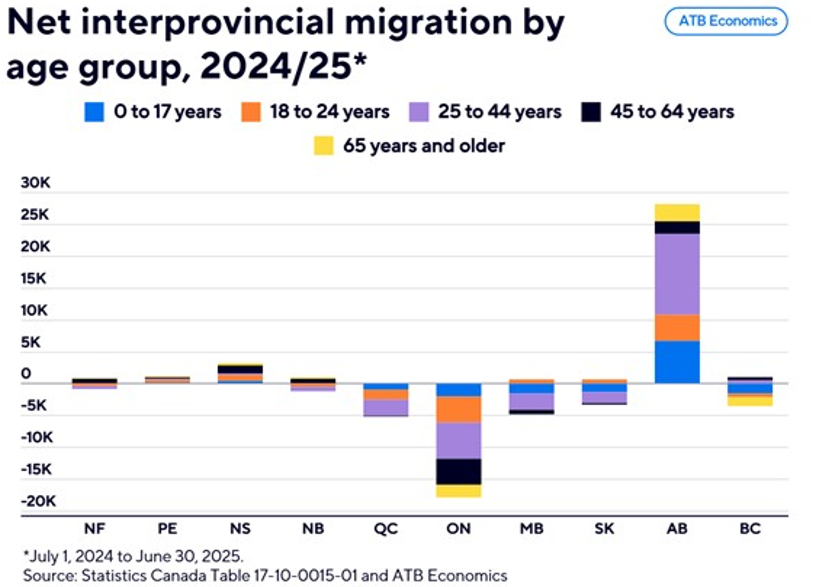
Oil and Gas: Diversifying, But Losing Head Office Jobs
Alberta’s oil and gas sector has picked up over the past few years after a slower stretch. Export diversification away from near-total reliance on the U.S. market has improved meaningfully since 2012, helped by the TMX pipeline and LNG capacity coming online in BC, which opens access to Asian markets including Japan and China. That diversification is a buffer against future trade disruption with the U.S., even if current tariff tensions get resolved.
At the same time, several major producers have announced workforce reductions. Imperial Oil is closing its Quarry Park headquarters in Calgary and moving remaining staff to Edmonton, while retaining Alberta operations. ConocoPhillips has announced a 25% global workforce cut, with a similar reduction expected in Canada. These cuts appear to be driven by efficiency gains rather than falling production, output is still rising, it’s just requiring fewer people to achieve it.
Tech Sector: Calgary’s Fastest-Growing Economic Diversifier
Calgary’s tech sector has been a bright spot for several years running. In CBRE’s 2025 Scoring Tech Talent report, Calgary ranked 17th overall among North America’s top tech markets, moving up three spots from the previous year, with its tech workforce growing 61.1% between 2021 and 2024. A few years ago, Calgary wasn’t even inside the top 100 on this list. That kind of movement matters for investors because it signals real economic diversification beyond energy, which historically has been a source of volatility in Calgary’s rental and resale demand.
Understanding Inflation and Why It Matters More to Real Estate Than You Think
This next section comes from Layne Walters, who broke down inflation and its relationship to real estate returns.
Inflation isn’t just a backdrop, Layne argues it’s directly responsible for a large share of long-term real estate returns, in a way that goes beyond the simple idea that “real estate is a hedge against inflation.” His point: prices for everything, wages, groceries, home values, tend to rise together over time. A $30 grocery bill today might cost $60 in a decade, but it still buys the same amount of food. Minimum wage might double, but it still buys the same two jugs of milk per hour worked. Nothing has fundamentally changed except the number attached to it.
Where this becomes powerful for real estate investors is the mortgage. A mortgage balance is a fixed dollar figure. As inflation pushes the numerical value of everything else higher, including rents and property values, that original mortgage amount doesn’t grow with it.
“It’s actually enhanced by inflation. It accelerates the return that you get.”
In other words, the “appreciation” investors track is largely inflation working in their favour, because the debt used to buy the asset is being repaid in dollars that are worth progressively less.
Layne also connected this to government debt strategy. Governments generally have two conventional ways to manage debt: raise taxes or cut spending. Both are politically difficult and can slow the economy. The alternative, and the one governments tend to favour, is quantitative easing (a central bank policy of purchasing government bonds to inject money into the economy, which tends to be inflationary over time). He pointed to CMHC quietly stepping back from a past mandate to restore housing affordability to 2004 levels, arguing that a real price decline of that scale would be financially destabilizing, as one sign that policymakers are more likely to hold prices flat than let them fall.
As evidence that inflation pressure is ongoing, Layne pointed to recent labour disputes, including the Alberta Teachers’ Association rejecting a 12% raise over four years, a BC public sector strike, and Canada Post workers rejecting an offer of roughly 13.5% against a reported demand closer to 19%. His view is that recent 20% settlements in some sectors, like nursing, will put upward pressure on other negotiations.
Where We Land: A Slower Winter, Then Recovery
Putting it all together, we expect prices and rents to keep softening into the winter, with a period of recovery to follow once the current oversupply works through the system. For long-term investors, the short-term direction of the market matters less than buying the right property. Some of the best-performing properties in our own portfolios were purchased at prior market peaks, right before a downturn, and they’ve still turned into strong, cash-flowing assets over the long run because the fundamentals (location, layout, income potential) were right from the start.
The current slowdown is creating real opportunity. Quality listings are becoming more available, buyers have more room to negotiate conditions and complete proper due diligence, and competition on well-located, well-laid-out properties has eased. That said, underwriting needs to reflect current reality: further rent softening through the winter and continued buyer leverage in negotiations. If you’re building a portfolio meant to hold for 20-plus years, this kind of market is often where the strongest long-term additions get made.