Key Takeaways
- Calgary’s Secondary Suite Amnesty Program ends December 31, 2026. Suites built before March 2018 lose eligibility for reduced code requirements (no separate heat source, no separate air circulation, no added sound dampening) after that date.
- As of the end of July 2026, secondary suites became a permitted use across the city, meaning a qualifying suite can go straight to a building permit instead of a discretionary development permit and public hearing.
- Calgary now has more than 26,000 registered legal suites. The city’s own spot-checks suggest roughly 61% of suites currently advertised for rent are registered, up from about 17% in 2022.
- Both the Secondary Suite Incentive Program (up to $10,000 per suite) and the Backyard Suite Incentive Program (up to $35,000) have exhausted their current funding and are accepting waitlist applications only.
- Legal suites generally add real value to a property, but local investors and realtors in the room pegged that value at $30,000–$70,000, not the $100,000+ some sellers hope for.
- Backyard suites make strong financial sense as rental income or multigenerational housing, but so far they don’t reliably add resale value equal to what they cost to build.
- Development permit fees for suites, waived since 2018, are expected to return in 2027, pending the City’s November budget decisions.
Secondary suites — basement suites, in plain terms — have quietly become one of the most important housing and investment stories in Calgary. They’re also one of the areas where the rules change often enough that it’s easy for an investor to fall behind, especially with a major deadline now on the horizon.
At a recent Calgary REI Hub meetup, we welcomed back Joshua Howes, the City of Calgary’s Secondary Suite Program Manager, who first spoke to our group a couple of years ago. Joshua has spent more than 15 years at the City, moving through the front counter, call centre, and bylaw enforcement before landing in leadership roles in planning and development. For the past several years, he’s been the person responsible for turning Calgary’s secondary suite program around.
What follows is a summary of what he told us: where the secondary suite program has been, where it’s headed, what the amnesty deadline actually means for your investments, and what’s happening with backyard suites, Calgary’s newest housing opportunity.
How Calgary’s Secondary Suite Program Got Here
Before 2018: A System Working Against Itself
Joshua was candid about how bad things used to be. Before 2018, Calgary had fewer than 500 legal secondary suites in the entire city. Every suite required a full development permit, and most required a public hearing and a rezoning just to be considered — a process Joshua described as “sad stories about how I want my mom to live in the basement, and I can’t do it because my zoning doesn’t allow for it.”
Enforcement wasn’t much better. Inspectors would show up, find the oven missing from an illegal suite’s kitchen (making it technically not a second dwelling), and leave — only for the oven to reappear once they were gone. Joshua’s team called this “the oven hokey pokey.”
2018: The Reforms That Changed Everything
In 2018, the City made several changes that mattered a lot more than they might have seemed at the time:
- Secondary suites became a listed, though still discretionary, use in most residential zones, meaning homeowners could at least apply.
- Development permits were no longer required for suites that met the rules — applicants could go straight to a building permit.
- The original amnesty program launched, reducing the cost of legalizing older, existing suites.
- Enforcement shifted from a fee-and-fine approach to an education-first approach.
2023–2024: A Dedicated Program and a Financial Incentive
The City launched its formal Secondary Suite Program in 2023, aimed at increasing safe, affordable housing and giving real value to suite registration. It also published a secondary suite guidebook that walks homeowners through the legalization process.
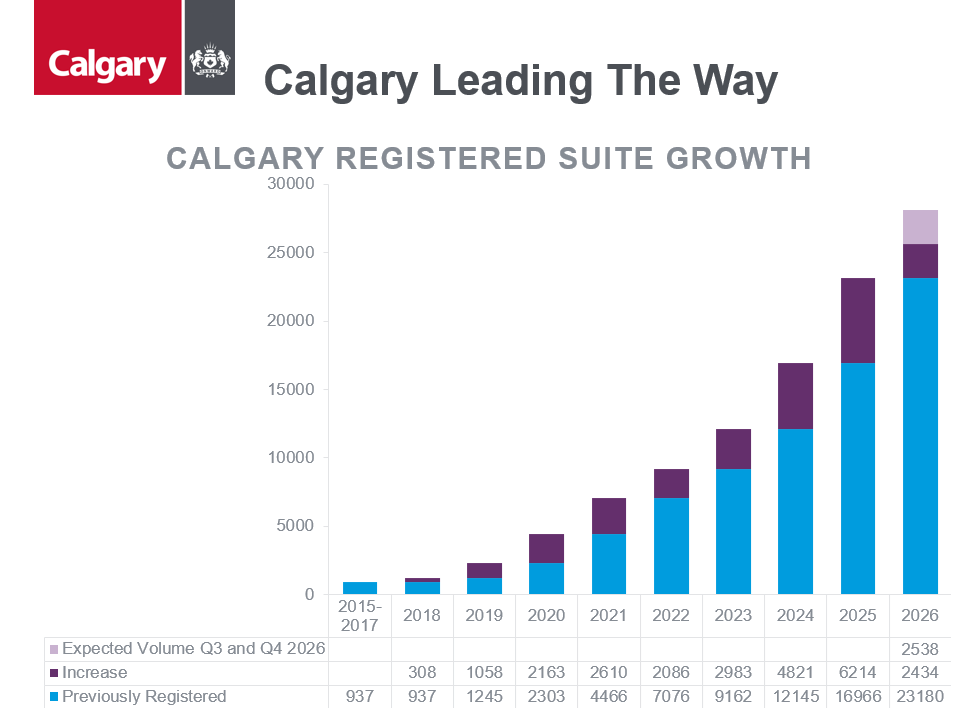
Then, in May 2024, the City launched the Secondary Suite Incentive Program, offering up to $10,000 toward the cost of the required safety upgrades. According to Joshua, Calgary averaged roughly 2,300–2,500 new registered suites a year in the three years before the incentive existed — and has more than doubled that annual pace in the two years since.
Where Registration Stands Right Now
As of this presentation, Calgary has surpassed 26,000 registered legal secondary suites — the largest volume of any city in the country. Joshua was clear about one thing, though:
“The city has built zero secondary suites over that time period. This is always a private investor, a homeowner, someone that is living in the City of Calgary that has taken the time to do the things required to provide a safe space for people to live in… So our success is your success.” – Joshua Howes
That’s a useful frame for investors: the City can build the pathway, but the actual supply — and the actual return — comes from private owners choosing to legalize.
The City also periodically checks how many suites currently advertised for rent are actually registered. That number has moved fast:
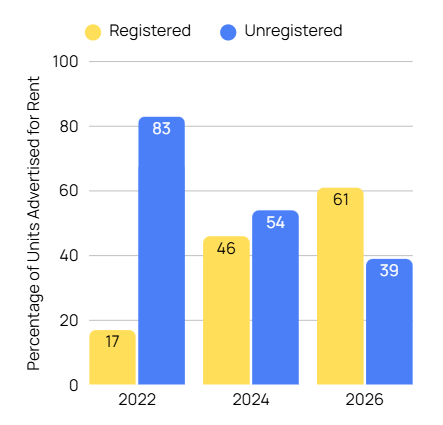
Joshua noted these are cross-sectional spot checks (a few hundred listings at a time), not a full audit, so treat them as directional rather than exact. Still, the trend matters: as registered suites approach a majority of the rental market, unregistered suites increasingly stand out — which changes the enforcement calculus for the City, and the risk calculus for owners.
The Amnesty Program Is Ending December 31, 2026
This is the single most time-sensitive piece of information in this article for any investor holding an older, unregistered suite.
The code amnesty for secondary suites applies only to suites that existed before March 2018. It has already been extended three times. Joshua was direct that this time is very likely the last:
“So unfortunately for those that aren’t here in this room… they don’t know that their illegal suite is about to drop in value significantly in four months. So if you got one, do something with it now, because I suggest that the value will significantly drop.”
Here’s what changes after December 31, 2026, for a pre-2018 suite that hasn’t been legalized:
- Full code requirements apply. A separate heating and air-circulation system and sound dampening between units — typically the most expensive parts of a legal conversion — become mandatory again, pushing the cost of legalizing from roughly $10,000–$15,000 up toward $50,000 or more.
- Permit intake started before the deadline is grandfathered. If you get your permit application in before December 31, 2026, you’re still processed under the amnesty rules, even if the work itself finishes later.
- Fees may return. Development permit fees for suites have been waived since 2018. Joshua expects that to change pending the City’s November 2026 budget process, along with a possible move to requiring full drawings, which existing suites haven’t needed for 8–10 years.
One counterintuitive point Joshua raised: ending the amnesty may actually push down the resale value of illegal suites, because the “easy” $10,000–$15,000 path to legalization disappears. If it’s going to cost a future owner $50,000+ to legalize, buyers will price that in.
Secondary Suites Are Now a Permitted Use Citywide
On top of the amnesty timeline, Calgary City Council voted to make secondary suites a permitted use across every residential zone in the city, rather than a discretionary one.
The practical difference for investors:
- Discretionary use (the old rule): the City could approve, deny, or attach conditions to a suite application, and it could require a public hearing.
- Permitted use (the new rule): if your suite meets the zoning, building, fire, and safety requirements, it’s automatically approved — straight to a building permit.
Backyard suites were not included in this change and remain discretionary, which we’ll come back to below.
What a Legal Secondary Suite Actually Does to Property Value
This turned into one of the more lively parts of the evening, with several realtors and investors in the room sharing their own rules of thumb. There was no single agreed-upon number, but a few patterns emerged:
- Several people estimated an illegal suite adds roughly $30,000 in perceived value.
- A legal, registered suite was more commonly valued at $50,000–$70,000 more.
Joshua’s own numbers, based on what the City sees at construction, put the actual cost to build a legal secondary suite at $70,000–$90,000 — which is worth keeping in mind when comparing “value added” claims to what the work actually costs.
A few other factors came up that are worth flagging for investors:
- It depends on the property type. A suite in a traditional starter home can eat the finished basement or storage space, which one attendee argued makes the home less desirable to an owner-occupier family, even while it’s more desirable to an investor.
- Renters mostly don’t care whether a suite is legal — several attendees agreed tenants rarely know, or ask, and rents for legal and illegal suites are often similar. The value gap shows up at sale, not at lease-up.
- New-build math has shifted. For a while, lenders were valuing the projected rental income from a suite highly enough that buyers could increase their overall purchase budget by including a suite — not just recoup the suite’s cost, but unlock more house. Whether that continues is worth confirming with your mortgage broker before you count on it.
Safety and Insurance: The Real Cost of Staying Illegal
Beyond property value, Joshua made the safety case directly. Full code for a secondary suite requires egress windows (windows large enough for someone to escape through, and for firefighters to enter through, in an emergency), interconnected smoke and fire alarms, a smoke seal (a drywall or sealed barrier that slows the spread of smoke between the suite and the rest of the house) with a protected exit, and a separate heating and air circulation source.
The reasoning behind the interconnected alarm requirement, in Joshua’s words: if two households aren’t living together, the person upstairs has no way of knowing something is wrong downstairs unless the systems are linked. An interconnected alarm is what tells the upstairs occupant to check on the situation before it’s too late.
The separate heat requirement matters for a less obvious reason: tenants in suites without their own heating source sometimes turn to space heaters when they can’t control the temperature. Joshua pointed to fire data suggesting kitchens and portable heaters are common causes of home fires generally, and referenced a fire he associated with a space heater as a cautionary example.
On insurance, Joshua shared a conversation he’d had with a homeowner whose illegal suite caught fire. That homeowner had told his insurer he was renting out the space and had his premium adjusted accordingly — and his claim was ultimately paid. Joshua was careful to frame this as one example, not a guarantee: coverage after a fire in an illegal suite isn’t automatic, but it’s also not automatically denied. He was clear, though, that the uncertainty itself is the risk — without a legal suite, the strength of your overall insurance protection isn’t something you can count on.
The practical takeaway for investors: whether or not your municipal permit is legalized, tell your insurance provider you’re renting out a secondary suite, and confirm in writing what is and isn’t covered.
Backyard Suites: Calgary’s Newest, Most Underbuilt Housing Type
The back half of the evening shifted to ADU’s, which are accessory dwelling units, a secondary, self-contained living space on the same lot as a primary home. In Calgary this most often means a “backyard suite”: either an at-grade unit or a suite built above a detached garage. Calgary currently has fewer than 400 legal backyard suites citywide — a number Joshua called “extremely underutilized” as a housing form, especially compared to basement suites.
The Backyard Suite Incentive Program
The City launched a Backyard Suite Incentive Program in March 2026, funded in part by $10 million from the federal Housing Accelerator Fund.
The program also includes:
- Up to $7,500 for accessibility features (at-grade access or an elevator/lift)
- An added bonus for projects that meet the Land Use Bylaw without needing any relaxations
Like the secondary suite program, this one saturated its funding fast — roughly five months after launch — and is now on a waitlist, with over 300 signed agreements already in place, expected to nearly double Calgary’s backyard suite count over the next two years.
Why Backyard Suites Make Sense to Build — But Not Yet to Flip
Joshua shared a candid observation from the program: of roughly 300 signed agreements, more than 70% of applicants could already name the specific person — often an aging parent — who was going to live in the suite. Backyard suites, in other words, are mostly being built for a known purpose, not as a speculative addition.
The financial picture supports that pattern. Rental income from a backyard suite pencils out well: Joshua cited one Bridgeland example where the projected rent from a two-bedroom above-garage suite would have covered more than the interest on an entire $2 million property. But resale is a different story — a $300,000–$350,000 backyard suite doesn’t reliably add $300,000–$350,000 to a home’s sale price. Much of that gap comes down to underground infrastructure (power, water, and sewer lines to the new structure), which buyers and appraisers tend not to value the way they value finished living space. The City’s incentive program was specifically designed to offset that infrastructure cost, recognizing it as the piece of the budget that “doesn’t make sense to everybody.”
That said, one host offered a pointed caution worth repeating for anyone weighing a backyard suite purely as an investment play: if a backyard suite only pencils out because of a rosy income projection, the same capital might do more for you spread across a second property — better cash flow, and two appreciating assets instead of one larger, depreciating structure on a single lot.
Backyard Suites vs. Tiny Homes and RVs
One audience question worth addressing directly: can you just put an RV or tiny home in your backyard instead? Joshua’s answer was nuanced. An RV that stays on its wheels occupies a legal gray area that’s evolved since the pandemic, when the City relaxed some restrictions on allowing family members to stay in an RV on a residential lot. But the moment a tiny home comes off its wheels and becomes a permanent structure, it must meet full Alberta Building Code — and Joshua was blunt that a typical loft-style tiny home, with a ladder or narrow staircase to a sleeping loft, will never meet that code. There’s no realistic path to a fixed, code-compliant “tiny home” ADU in Calgary under current rules.
What This Means for Calgary Investors
- If you own a pre-2018, unregistered suite: start the legalization process now. Waiting past December 31, 2026, likely means a jump from roughly $10,000–$15,000 in upgrade costs to $50,000 or more.
- If you’re buying a property with an “unregistered” or unverified suite: don’t assume it qualifies for the amnesty just because it’s old. Confirm the suite existed before March 2018 — Josh’s team increasingly relies on things like MLS listing history and old street-view imagery to verify this, and you should too.
- If you’re planning a new suite: the amnesty doesn’t apply to you regardless of timing — new suites have always required full code. But the shift to a permitted use should speed up your approval process.
- If you’re considering a backyard suite as a pure investment play: run the numbers carefully. The rental income case is strong; the resale case, so far, is not.
- Either way, check with your insurance provider about how an unregistered suite affects your coverage before you rent it out.
FAQ
Does the code amnesty apply to brand-new suites?
No. It only applies to suites that existed before March 2018. A new suite, or one built or substantially renovated after that date, must meet full current code, including separate heat and sound dampening, regardless of the amnesty deadline.
Is the Secondary Suite Incentive Program still accepting applications?
It moved to a waitlist in mid-2026 after exhausting its budget. As of this talk, the City had over 350 applicants on the waitlist, representing roughly $3 million in requested funding, and won’t know whether more money is available until the City’s November budget process.
Is there a similar incentive for backyard suites?
Yes. The Backyard Suite Incentive Program launched in March 2026 with support from federal Housing Accelerator Fund money, but it also saturated its funding quickly and is now processing a waitlist.
How will the City enforce against remaining illegal suites once the amnesty ends?
Joshua confirmed the City is already working through a backlog of suites it’s aware of and expects to have contacted all of them by the end of 2026. He anticipates further public communication in November 2026 reinforcing the deadline, and said enforcement priorities will shift once registered suites represent a large majority of the rental market, since it becomes harder to justify going after a smaller and smaller share of holdouts.
Are code inspectors consistent in how they interpret the rules?
Joshua acknowledged this has historically been a real pain point — different inspectors sometimes required different things on the same file. The City reduced its existing-suite inspection zones from four to two and started keeping the same inspector on a file from plans review through final inspection, which he says has meaningfully improved consistency, though some differences in interpretation still exist.
Can I put an RV or tiny home in my backyard instead of building a suite?
An RV that stays on its wheels currently falls into a legal gray area that loosened somewhat after the pandemic, though rules on parking and use vary. A tiny home that’s been taken off its wheels and installed as a permanent structure must meet full Alberta Building Code, which a typical loft-style tiny home is not built to meet.
A Final Word
Calgary’s secondary suite program has come a long way from the “oven hokey pokey” days — and the City’s own numbers back that up. But the amnesty deadline is real, and it’s close. If you own, or are buying, a property with an older basement suite, the math on legalizing it gets significantly worse after December 31, 2026. Backyard suites, meanwhile, are still early: a genuinely underbuilt housing type with strong rental fundamentals, but not yet a reliable resale play. As always, run your own numbers before committing, and don’t hesitate to reach out to our team if you want a second opinion on a specific property.