
Key Takeaways
- Creative financing in Alberta includes vendor take-back (VTB), assignment of contract (wholesaling), limited partnerships (LPs), joint ventures (JVs), caveat loans, private mortgages, agreement for sale (AFS), and rent-to-own/lease-option structures.
- Vendor take-back financing works best when sellers have little or no existing mortgage and are open to deferred or structured payment.
- Assignment of contract (wholesaling) is legal in Alberta when the purchase contract doesn’t explicitly prohibit it — but volume wholesaling without a real estate license carries regulatory risk.
- Joint ventures are contractual and flexible, but under-documented JVs are the most common source of investor disputes and litigation.
- Agreement for Sale (AFS) gives buyers the strongest legal position of any creative structure — including equitable ownership and foreclosure protections — but requires experienced lawyers on both sides.
- Rent-to-own (lease + option) gives sellers more control and faster exit but provides buyers significantly fewer legal protections than AFS.
- Caveat loans are simple and low-cost but offer weaker remedies than a registered mortgage — always include a charging clause and prefer a mortgage when possible.
- Alberta’s non-recourse mortgage rules apply to personally-held properties; corporate purchases typically require a personal guarantee, eliminating that protection.
- Disclosure to lenders in JV and AFS structures is legally required. Failure to disclose equitable ownership interests constitutes mortgage fraud.
- Always have a Plan B exit strategy — particularly for AFS structures — because conventional banks often won’t finance the buyout at maturity.
Introduction
Creative financing strategies are generating a lot of buzz in Calgary real estate investing circles — and for good reason. They open doors for buyers who can’t qualify for conventional mortgages, sellers who want structured payouts, and investors who want to move faster or build portfolios without constant reliance on traditional lending.
But creative financing also comes with real legal complexity, and getting the structure wrong can cost you — sometimes badly. We brought in Scott Bollinger, a Calgary-based real estate lawyer at Bollinger & Associates, to break down the most common creative financing structures used in Alberta, how they actually work under the law, and where investors tend to run into trouble.
Scott brings a rare perspective to this topic. Before becoming a lawyer in 2018, he was a realtor, held a mortgage broker license, ran a mortgage investment corporation, and operated a real estate brokerage. He’s seen these transactions from every angle — and he pulls no punches about what works and what doesn’t.
Note: The information below is educational in nature and does not constitute legal advice. Always consult qualified legal counsel before entering into any creative financing arrangement.
Vendor Take-Back Financing (VTB)
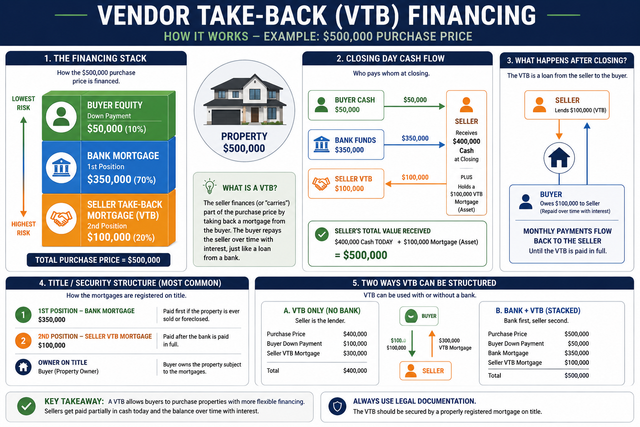
Vendor take-back financing is a purchase structure where the seller provides some or all of the financing directly to the buyer. Rather than the buyer securing a full mortgage through a bank, the seller essentially becomes the lender for a portion of the purchase price — and that loan is registered on title.
For example: a buyer purchases a $400,000 property, pays $100,000 down, gets a $200,000 conventional mortgage, and the seller takes back a $100,000 mortgage. All parties agree on the terms, and the deal closes.
When Does VTB Make Sense?
VTB works best when the seller owns the property outright or has a small enough mortgage that it can be paid off from the buyer’s cash contribution at closing. Sellers carrying large mortgages generally can’t offer this structure.
It’s also dependent on finding a seller who’s willing to stay financially tied to the property for a period of time after the sale — something many sellers simply don’t want. But they do exist, and there are scenarios where VTB is a compelling option for both sides.
Scott shared a real example from the Silver Lake area: an older seller wanted more than market value for his property, and an investor agreed to pay a premium in exchange for the seller taking back financing. The buyer then used the property as a short-term rental and eventually refinanced out of the VTB. A clean outcome that worked because both parties had aligned incentives.
Developers and builders are another potential VTB market — particularly when acquiring older properties from sellers without a mortgage, where VTB allows the developer to control the property while working through permits or planning before completing the full purchase.
Tax Considerations
One question that came up: when does the seller’s capital gain trigger on a VTB transaction? Scott’s view is that there’s a reasonable argument that the gain accrues over time as payments are received, rather than all at once on closing. But this is a grey area — he recommends consulting a tax professional rather than assuming CRA will see it your way.
Assignment of Contract (Wholesaling)
Wholesaling — formally called assignment of contract — has grown significantly in popularity in Calgary over the past several years. The model is straightforward: an investor puts a property under contract with a seller, then assigns the rights (and obligations) of that contract to a third-party buyer before closing, collecting a fee for doing so.
Is It Legal in Alberta?
Yes — with some nuance. In Alberta, contracts are assignable by default unless the contract explicitly prohibits it in writing. If your purchase contract is silent on assignment, you can generally do it.
That said, there are meaningful risks to understand:
- Liability doesn’t automatically transfer. If you assign a contract to a third-party buyer and that buyer fails to close, you — as the original party with privity of contract — remain liable to the seller for damages. Getting a formal release from the seller is the clean way out, but sellers often have little incentive to grant one.
- Amending vs. assigning. Some people try to get around this by simply amending the buyer name on the contract. The problem: doing so blurs whether you actually completed an assignment (and are entitled to an assignment fee) or just amended a contract, which doesn’t support a fee.
- The real estate license question. The Alberta Real Estate Act requires a license if you’re “trading in real estate,” which is broadly defined as bringing parties together for compensation. On a one-off or occasional basis, the argument that you hold a purchaser’s interest and are simply transferring your own stake is defensible. But if you’re wholesaling systematically and at volume, you may need a real estate license.
“On a one off basis or a periodic basis, I think the argument that you don’t need a real estate license is a safe legal argument to protect you, as you have an interest in the property. But if you do this on a more systematic basis, you may want to consider whether you need a real estate license because that colors the interpretation.”
Limited Partnerships (LPs)
Limited partnerships are a well-established way to pool capital from multiple investors for a real estate deal. A general partner manages the investment; limited partners contribute capital and share in returns while having limited liability.
Scott doesn’t handle LP structures himself — they trigger securities law requirements that require specialized expertise — and he always refers clients to lawyers who focus in that area. The setup costs are higher than simpler structures, and the compliance requirements are more involved. There are plenty of success stories, but also some notable failures when LPs are not set up or governed correctly.
If you’re considering an LP, engage a securities lawyer early. This is not a DIY structure.
Joint Ventures (JVs)
A joint venture is a contractual arrangement between two or more parties to co-invest in a property. Unlike LPs, JVs don’t fall under securities legislation — they’re governed entirely by the contract you write. That flexibility is a major advantage. It’s also where a lot of investors get into trouble.
How JVs Are Typically Structured
A standard JV agreement will cover:
- How the property is managed
- How profits and losses are shared
- Exit strategies
- The purpose of the venture
- Decision-making authority
A common setup is a “money partner” who provides capital and a “working partner” who brings the deal and manages execution. That structure is valid — it’s contractual and you can write it however works for you. But from a CRA perspective, the more both parties share in both profits and losses, the stronger the argument that it’s a genuine joint venture rather than a loan or some other arrangement that CRA might characterize differently.
Disclosure Requirements in JVs
A situation Scott sees often: one partner qualifies for a mortgage and goes on title; the other partner contributes money but stays off title. The off-title partner has equitable ownership through the JV agreement.
This can work — but you must disclose the equitable ownership arrangement to the lender. Failing to do so isn’t just risky — it’s mortgage fraud. Not every lender will accept this arrangement, but plenty will. Find one who’s comfortable with it, be transparent, and do it properly.
The off-title partner should also protect their interest by registering a caveat on title pursuant to the JV agreement. That caveat costs a couple hundred dollars through a lawyer and puts everyone on notice that there’s another interest in the property.
Where JVs Go Wrong
Joint ventures are, in Scott’s experience, the structure most likely to end up in litigation. The reason: the low bar to entry. Two people shake hands, maybe sign a three-page document, and call it a JV. Two years later they disagree on everything and there’s no mechanism in the contract to resolve it.
If there’s no governing legislation, the only mechanism to force a resolution is court — expensive, slow, and avoidable with a properly drafted agreement from the start.
Caveat Loans vs. Private Mortgages
Caveat Loans
A caveat loan is a quick, low-cost way to lend money secured against real estate. The lender registers a caveat (A caveat is a notice registered on the title of a property that alerts other parties to the existence of a claim or interest. It does not grant the same enforcement powers as a mortgage) on the borrower’s property, which gives notice of their interest and ties up the title.
The problem: caveats are a weaker form of security than a mortgage. They can be removed if the caveat holder doesn’t respond to a notice in time. And critically, they don’t give you foreclosure rights. If a borrower stops paying, you can’t force a sale — you can only wait them out until they try to sell or refinance.
Scott recommends always including a charging clause in any loan agreement — a clause that explicitly authorizes you to register your interest against the borrower’s real estate. Without it, if the borrower doesn’t pay, your only option is to sue, get a judgment, and then try to recover — a process that can take years and often yields nothing.
Private Mortgages (Scott’s Preferred Lending Structure)
Scott’s personal preference for lending is a registered private mortgage. A mortgage gives you actual foreclosure rights — you can force a sale if the borrower defaults, rather than simply waiting. It also provides stronger, cleaner priority on title.
Yes, mortgages cost a bit more to set up (more documents, must be signed in person, registered at Land Titles). But in a transaction involving hundreds of thousands of dollars, the additional cost is minor relative to the protection you get.
Private lending opportunities often surface through networks of lawyers, mortgage brokers, and other real estate professionals. Scott’s office regularly sees bridge loan opportunities — borrowers who need short-term funds to close a purchase before their sale completes. These can work well for private lenders who want relatively passive, secured returns.
One notable feature: registered funds (RRSPs, TFSAs) held in self-directed accounts through trust companies like Olympia Trust can be used to fund private mortgage loans. This lets you put tax-sheltered capital to work in secured real estate lending.
Olympia Trust self-directed RRSP lending
Agreement for Sale (AFS)
Agreement for Sale is one of the more powerful — and more misunderstood — creative financing structures in Alberta. It gets confused with rent-to-own constantly, so let’s be precise about what it actually is.
What Is an Agreement for Sale?
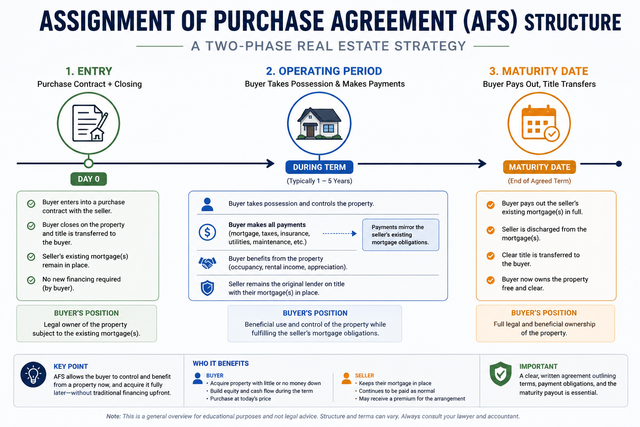
AFS is a purchase transaction with seller financing, where the seller’s existing mortgage stays on title and the seller also remains on title — at least temporarily. Unlike a vendor take-back, where the mortgage is fully paid out and title transfers on closing, an AFS works like this:
- Buyer and seller enter a purchase contract and close on a short timeline (e.g., April 1st).
- Buyer pays a portion of the purchase price upfront.
- The balance is financed by the seller, typically mirroring the seller’s existing mortgage terms and payment structure.
- The seller remains on title; the seller’s mortgage stays in place.
- The buyer takes possession and operates the property as owner, and gains equitable ownership (Equitable ownership means the buyer has a legal beneficial interest in the property — the right to use, profit from, and ultimately receive title — even though the seller’s name is still on the legal title) from closing.
- At a maturity date (typically 1–2 years), the buyer pays out the seller’s mortgage and any remaining balance, and title formally transfers.
Why AFS Is Attractive for Buyers
- No new mortgage required at entry. The buyer effectively steps into the seller’s financing structure. During periods of low rates, this was a significant advantage.
- Equitable ownership from day one. The buyer’s interest in the property is protected on title via registered caveat. This is a much stronger position than a rent-to-own or option arrangement.
- Foreclosure protection. If the buyer defaults, the remedy is foreclosure — not immediate forfeiture. As an individual buyer, you cannot be contractually stripped of your equity of redemption (Equity of redemption is the legal right of a borrower in default to reclaim their property by paying off the outstanding debt before a foreclosure is finalized). As a corporate buyer, this protection can be negotiated away, so be aware of what you’re agreeing to.
- Protection against seller’s creditors. If the seller has financial trouble after closing (e.g., a CRA tax lien gets registered), the buyer’s registered equitable ownership interest has priority — as long as it was properly registered before the lien.
AFS Risks to Know
Due-on-sale clause. The seller’s lender almost certainly has a clause in their mortgage prohibiting assumption without consent — and lenders don’t give that consent. Structurally, the AFS isn’t an actual assumption (the buyer’s financing mirrors but doesn’t replace the underlying mortgage), but if the lender discovers the arrangement and doesn’t like it, they can call the mortgage. Scott notes this has happened extremely rarely in his experience — real estate lawyers doing this in Alberta for 40+ years have rarely seen a lender actually exercise this right — but it’s a real theoretical risk. Have a Plan B.
Exit financing challenge. This is the most common practical problem. When the maturity date arrives, most conventional banks won’t refinance an AFS buyout because the title isn’t yet in the buyer’s name. The typical path is to use private financing to complete the buyout, then refinance conventionally once title transfers. Don’t leave this to the last two weeks — start working on it months in advance.
Seller’s financial health matters. You’re exposed to the seller’s liabilities as long as their name is on title. Vet the seller carefully. You don’t want to be dealing with multiple creditors chasing their equity after you’ve already paid for the property.
Dual closings. Properly structured, AFS involves two closings — one at entry and one at maturity. Both cost money (legal fees, document preparation). Budget for it.
Two lawyers required. The seller and buyer should each have their own legal counsel who understands AFS. The transaction is complex enough that shared representation creates too much conflict risk — and if the seller’s lawyer isn’t familiar with AFS, you’ll spend more time and money than you should.
Rent-to-Own / Lease and Option
Rent-to-own is a combination of a lease agreement and a separate option to purchase. The buyer rents the property and holds an option to buy it at a set price within a defined window. It’s a popular structure, and for certain situations it works very well. But it’s fundamentally different from AFS in ways that matter a lot, particularly for buyers.
AFS vs. Rent-to-Own: The Key Differences
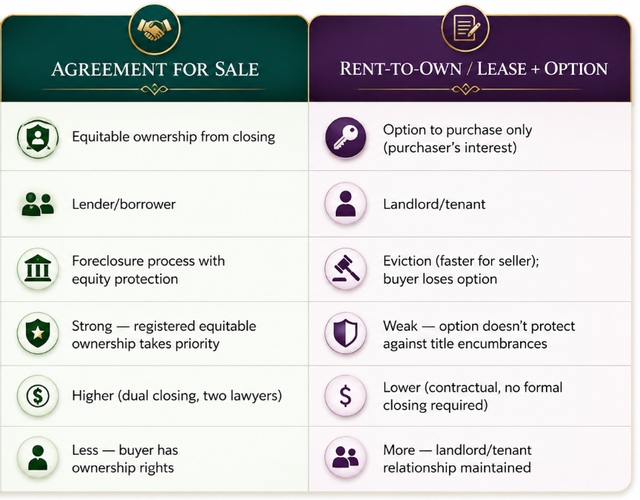
From an investor’s perspective, AFS is generally the better buy-side structure. Rent-to-own makes more sense from the sell side — particularly for investors who buy properties and sell them through lease-option to aspiring homeowners who can’t yet qualify for conventional financing.
Corporate Structures and Title Trust Arrangements
A common scenario: an investor qualifies for a mortgage personally, buys a property in their own name, and then later wants to hold it in a corporation for tax or liability purposes. Rather than actually transferring title — which triggers land transfer costs and lender notification requirements — investors sometimes use a bare trust agreement (also called a beneficial trust or bare trust declaration) that states the corporation has always been the beneficial owner of the property.
Scott’s take on this: it’s used regularly and it works from a tax perspective. CRA recognizes it. But important caveats apply:
- No liability escape. The trust arrangement doesn’t remove the personal borrower from the mortgage or personal liability. You are still on the hook.
- Lender notification. Under most mortgage terms, any change in ownership interest requires disclosure to the lender. Entering a trust arrangement that assigns beneficial ownership to a corporation likely triggers this. In practice, many investors don’t disclose and nothing happens — but if the lender finds out and doesn’t like it, they can call the mortgage.
- Corporate rental income tax. In Canada, rental income is considered passive income inside a corporation, which is taxed at a higher rate unless the business meets the threshold for active business income (generally requiring five or more full-time employees). For most individual investors, holding rental properties personally — not corporately — results in a better tax outcome. Talk to your accountant.
Alberta’s Non-Recourse Mortgage Advantage
Alberta is one of the only provinces in Canada where conventional residential mortgages (20% or more down) are non-recourse. That means if you default and the lender forecloses, the lender’s remedy is limited to the property itself — they cannot come after your other personal assets.
This is a meaningful protection for individual investors. However, it disappears the moment you purchase through a corporation and the bank requires a personal guarantee — which they almost always do on corporate mortgages. At that point, you’re fully personally liable regardless of how the property is held.
Law of Property Act, RSA 2000, c L-7, s 40 — Alberta’s non-recourse mortgage provision
Scott’s Honest Take: What Works and What Doesn’t
When asked about his favourite and least favourite structures, Scott was direct:
Favourite: Agreement for Sale. When the right conditions are in place — a seller who understands what they’re signing, experienced lawyers on both sides, and a buyer with a clear exit plan — AFS is a powerful structure that provides genuine ownership rights and flexibility.
Most common failures: Joint Ventures. Too easy to enter, too often underdocumented. If your JV agreement doesn’t spell out exit strategies, dispute resolution, and what happens when partners disagree, you’re setting yourself up for an expensive legal fight.
Biggest red flag: unsecured promissory note lending. Investors who lend money on a signed note with no registered security on real estate have almost no practical recourse when things go sideways. Always secure your lending position — at minimum with a charging clause that allows registration, and ideally with a registered mortgage.
FAQ
Q: Have banks ever actually called a mortgage when they discovered an Agreement for Sale arrangement?
A: According to Scott, this is theoretically possible but rarely — if ever — happens in practice. He and other experienced Alberta real estate lawyers who have worked in this space for decades have not seen a lender exercise this option. That said, it’s not impossible, so you should always have a backup plan (typically private financing) in case the underlying mortgage gets called before your AFS maturity date.
Q: On a vendor take-back, can the seller spread their capital gain over the term of the financing rather than declaring it all at once?
A: There’s an argument to be made that the seller hasn’t received the full purchase price until the financing is paid out, and therefore hasn’t fully realized the gain yet. Scott believes this argument has merit but cannot guarantee CRA will accept it. Consult a qualified tax advisor before assuming you can defer the gain.
Q: Is it possible to sub-sell or assign your position under an AFS to a third party?
A: Technically yes. But Scott advises significant caution. You would have two sets of legal obligations — one to the original seller and one to the third-party buyer — and if you default under the AFS, your third-party buyer’s position is also jeopardized. It gets complicated fast and Scott has seen these situations go poorly.
Q: In a joint venture where one partner has over 50% ownership but is off title, can they force a sale?
A: Only if the JV agreement provides that mechanism. If it’s clearly spelled out in a well-drafted agreement, you have contractual grounds to act. If the agreement is silent on this, you would likely need to litigate — go before a judge and make the case for your controlling interest. There’s no automatic legislative mechanism to force a sale in a JV the way there might be in a corporation with share provisions. This is why the agreement matters so much.
Q: What’s the difference between an AFS and simply assuming the seller’s mortgage?
A: Mortgage assumption used to happen regularly in Alberta decades ago. Today, lenders don’t permit it — they require the new buyer to requalify and they’d rather issue a new mortgage at current rates than let someone inherit a low-rate mortgage. An AFS is not a formal assumption; it mirrors the underlying mortgage terms through seller financing. The underlying mortgage stays in the seller’s name. The result is functionally similar from a payment perspective, but legally quite different.
Q: How does a joint venture partner who is off title protect their ownership interest?
A: The JV agreement should include a charging clause giving the off-title partner the right to register an interest against the property. They would then register a caveat on title through a lawyer — typically a straightforward process costing a couple hundred dollars. This puts any future lenders, buyers, or creditors on notice that there’s another party with an interest in the property.
Q: Can I buy a property personally, get the mortgage, and then hold it in trust for my corporation for tax purposes?
A: Yes, bare trust or beneficial trust arrangements are used for this purpose and CRA recognizes them. However, it doesn’t eliminate your personal liability on the mortgage, and under most mortgage terms you’re technically required to notify the lender of changes in ownership interest. Also, note that rental income earned inside a corporation is generally taxed at a higher rate than personal income for most investors, so confirm with your accountant that this structure actually improves your tax position before proceeding.