Key Takeaways
- Calgary’s definition of a short-term rental (STR) changed from stays under 30 days to stays under 180 days, effective April 1, 2025, closing the gap on medium-term rentals.
- Condo board consent is no longer required by the City for an STR business licence, though condo bylaws that prohibit short-term rentals still apply.
- A moratorium on new non-primary residence STR licences is tied to the CMHC purpose-built rental vacancy rate dropping to 2.5%, a threshold that has not yet been reached.
- Return on investment (ROI) and cash on cash return are different metrics, and cash on cash alone can be a misleading way to judge a deal.
- Short-term rentals typically carry higher property management fees (20-30%) than long-term rentals (8-12%), plus furnishing costs and the provincial tourism levy.
- Excluding vacancy and property management fees from your projections is one of the most common mistakes investors make when running numbers on a secondary suite.
- Success on Airbnb depends heavily on differentiation, guest screening, neighbour relations, and treating furnishings as commercial-grade rather than residential.
Deciding whether to short-term rent or long-term rent a secondary suite is one of the most common questions Calgary real estate investors ask us. The right answer depends on your property, your location, and your tolerance for the extra work short-term rentals bring. We sat down with Natasha Fleming, a full-time real estate investor with over 20 doors who previously worked as a financial advisor and mortgage broker, to break down the regulatory changes, the numbers, and the lessons she has learned from running short-term rentals in Calgary.
Calgary’s 2025 Short-Term Rental Rule Changes
Natasha walked the group through a set of licensing changes that took effect in Calgary on April 1, 2025.
New Definition: 30 Days to 180 Days
A medium-term rental generally refers to stays longer than a typical short-term stay but shorter than a standard year-long lease, often in the range of one to six months. Calgary’s short-term rental definition now covers any stay of up to 180 consecutive days, meaning operators who previously offered 30 to 180 day stays without an STR licence, thinking of them as medium-term rentals, now need to license the property as a short-term rental.
Licensing Fees
Fees differ depending on whether a property is a primary or non-primary residence, and whether you are applying for a new licence or renewing an existing one.
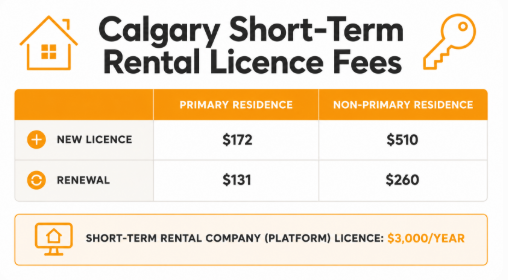
Natasha also flagged a new annual fee for short-term rental companies, or digital platforms. City of Calgary, Short-Term Rental Business Licence: Rules and Regulations
Condo Board Consent Removed
As of April 2025, the City no longer requires condo board consent as part of the STR business licence application. Natasha noted this had been a source of frustration for owners in buildings where boards were reluctant to sign off, even informally, on units that had been operating as short-term rentals for years. The change does not override condo bylaws. If a building’s bylaws prohibit short-term rentals, that restriction still stands, and enforcement becomes an internal condo matter rather than a City licensing requirement.
Moratorium on New Non-Primary Residence Licences
A pause on new non-primary residence STR licences is planned, but it is tied to the CMHC purpose-built rental vacancy rate falling to 2.5%. At the time of the presentation, Calgary’s vacancy rate sat around 4.8%, well above the trigger point. CMHC’s Rental Market Report, which tracks purpose-built rental vacancy rates, is published annually in the fall. Because the moratorium only activates once vacancy drops to the 2.5% threshold, it may not take effect for some time, and investors should watch CMHC’s annual report rather than assume a fixed start date.
Other Requirements
- Proof of ownership or owner consent, including an authorization form if a manager applies on the owner’s behalf.
- Proof of insurance confirming coverage for short-term rental use, with a minimum of $2 million in liability coverage, from an insurer registered in Alberta.
- A fire safety plan and an annual fire inspection.
Because these requirements can change, we recommend checking the City of Calgary’s short-term rental page before applying for a licence or purchasing a property with short-term rental plans.
Short-Term vs. Long-Term Rental: How to Decide
Natasha was clear that there is no universal answer here. The decision depends on the property, the neighbourhood, and the numbers.
ROI and Cash on Cash Are Not the Same Thing
Cash on cash return measures your yearly cash flow against the total cash you invested to acquire the property, including your down payment and closing costs. Return on investment (ROI) is a broader, longer-term measure that also accounts for what you would net if you sold the property, including debt pay-down and appreciation. Natasha’s formula for ROI: sale price plus cash flow plus debt pay-down, minus purchase price and all other costs, divided by total money invested, then divided by the number of years held to annualize it.
“The truth is that your leverage dictates your return on investment, and a higher return on investment means it’s a better deal.” — Natasha Fleming
She cautioned against a common misconception: a higher down payment often produces higher monthly cash flow, but that does not automatically make it the better deal. In her example, moving from a 20% to a 30% down payment increased monthly cash flow, but the annualized ROI actually dropped, because more capital was tied up to generate that cash flow.
Other Factors That Influence the Decision
- Tax treatment: short-term and long-term rental income are taxed differently, and short-term rental income is subject to Alberta’s tourism levy (see below).
- Workload: short-term rentals require more hands-on management unless you build out systems or hire a property manager.
- Location: a property might generate strong short-term rental cash flow on paper, but poor surroundings, parking, or curb appeal can hurt guest experience and bookings regardless of interior quality.
- Quality: Natasha described mismatched exterior and neighbourhood quality against a well-renovated interior as a “lipstick on a pig” situation that guests notice immediately.
Running the Numbers: A Worked Example
Natasha walked through an example: a $550,000 purchase with 20% down, $50,000 in renovations to create a secondary suite, and a $440,000 mortgage amortized over 30 years at 5% interest. Renting the basement at $1,500 and the main floor at $2,000 produces $42,000 in annual income.
The exercise highlighted a mistake she sees often: leaving vacancy and property management fees out of the calculation. Without those two line items, the numbers looked stronger than they actually were. Once included, a deal that appeared to generate $667 a month in cash flow worked out to roughly a 5% cash on cash return on $160,000 invested, a return Natasha said she personally would not pursue given the effort and risk involved compared to lower-effort alternatives.
She also compared 20% and 30% down payment scenarios on the same deal, holding vacancy and property management constant. The 30% down payment scenario produced higher monthly cash flow, but its cash on cash return was actually lower, since more capital had to be committed to achieve it. In a separate ROI comparison on similar numbers, ROI dropped from roughly 21% to 16% as the down payment increased, reinforcing that more cash into a deal does not always mean a better return.
Short-Term Rental Specific Costs
Beyond mortgage, property tax, insurance, and maintenance, short-term rentals carry a few additional cost categories worth budgeting for.
Alberta’s Tourism Levy
Natasha referenced a 4% Alberta tourism levy applied to short-term accommodation income, which was accurate at the time of this presentation.v (Note: As of April 1, 2026, the Government of Alberta increased the tourism levy from 4% to 6% on short-term accommodation, including Airbnb and VRBO bookings. Investors budgeting today should use 6%, not 4%. Also, effective October 1, 2024, provincial legislation requires online marketplaces like Airbnb and Vrbo to register and collect, report, and remit the levy directly, which addresses the uncertainty Natasha raised in the video about whether platforms were handling remittance. Government of Alberta, Tourism Levy) Hosts accepting direct bookings outside a platform remain responsible for registering with Alberta’s Tax and Revenue Administration and remitting the levy themselves.
Property Management Fees
Natasha estimated long-term rental property management fees in the 8-12% range, compared to 20-30% for short-term rentals, reflecting the added workload of turnovers, cleaning coordination, and guest communication.
Furnishing and Payback Period
She uses a simple payback metric for furnishing costs: if furnishing a unit costs $15,000, how long does it take for that investment to be recovered through additional income compared to a long-term rental? A one to two year payback feels reasonable to her; a five-year payback signals the short-term rental route may not be worth the added cost and effort for that property.
Lessons From the Field: Tips for New Airbnb Hosts
- Expect seasonality. Natasha described a $14,000 July compared to a $2,000 December on the same property, and stressed evaluating performance over a full year rather than reacting to a slow month.
- Differentiate the property. Generic finishes will not stand out in a crowded market. She pointed to a unique architectural feature in one of her own listings as the reason it consistently ranks in the top 5-10% on the platform.
- Budget for a property manager, even if you self-manage now. Running your numbers with a management fee built in protects you from being stuck managing the property yourself if you burn out.
- Stay close to regulation changes. Natasha pointed to British Columbia’s short-term rental restrictions as an example of how quickly rules can shift, and cautioned against relying on social media for regulatory information rather than official municipal or provincial sources.
- Build relationships with neighbours. She shared that a single Airbnb she operated near a lake led to noise complaints that contributed to a municipality-wide short-term rental ban. Sharing contact information with neighbours and responding quickly to concerns can prevent complaints from escalating.
- Remove problem items. Small details like shower caddies and bottle trays are easy for cleaners to miss and can leave a bathroom looking unkempt. Simplifying what is in the unit reduces cleaning errors.
- Furnish for commercial use. Short-term rentals see far more turnover than a typical residential property. Choosing durable, commercial-grade furniture, or budgeting for higher wear and tear, avoids repeated replacement costs.
- Screen guests, especially those without reviews. Asking about the purpose of a stay and the number of guests helps flag situations that do not add up before they become a problem.
- Put important details in multiple places. Listing a basement suite, shared walls, or expected traffic noise in the welcome message, house rules, and listing description reduces complaints and supports removing unfair reviews later.
- Keep instant booking on. Natasha has found the platform’s algorithm favours listings with instant booking enabled, and hosts can still restrict which guests qualify for it.
FAQ
Can you get a short-term rental licence for a single room in a house, rather than the whole unit?
Yes. Individual room rentals are permitted under Calgary’s short-term rental rules. This falls under what the City refers to as its lodging home regulation, which covers licensing for one to four rooms and separately for seven or more rooms.
Can you run a mix of short-term and long-term rentals in the same property?
Yes, and Natasha does this herself, long-term renting the bottom unit of one property while short-term renting the top. She noted the right mix depends on the property and location; what works well in one spot may not make sense in another, so it is worth running the numbers on both configurations before committing.
Where should investors get accurate short-term rental income estimates?
Natasha has used tools like AirDNA, Wheelhouse, PriceLabs, and the Airbnb website itself, but has found the estimates from these tools vary widely and are not always reliable. She now places more trust in her own operating experience and in getting input from short-term rental property managers who work with comparable properties daily. She also recommends getting more than one opinion, since even experienced investors can be out of step with fast-changing market conditions.
Does selling a former short-term rental property trigger GST or HST?
. An audience member referenced a case where the Canada Revenue Agency treated the sale of a property that had been used as a short-term rental as the sale of an active business, resulting in GST or HST owing on the sale price. Natasha was not able to confirm the details or how commonly this applies, and recommended speaking with an accountant, since tax treatment on the sale of a former short-term rental property can be complex and property-specific.
Can furnishing costs for a new Airbnb be written off in the first year?
According to Natasha, most furnishing purchases, like beds, couches, and other legitimate business expenses, can generally be written off, and smaller items are often deductible in the year purchased. Larger capital improvements to the property itself, as opposed to furnishings or maintenance, are typically written off gradually over multiple years rather than all at once. She was clear that this is not tax advice, and recommended working with an accountant to confirm the correct treatment for specific purchases and renovations.
Does the short-term rental company licence fee apply to individual investors, or only to platforms and management companies?
Based on the discussion, the annual short-term rental company fee applies to businesses operating as short-term rental platforms or management companies, not to individual owners managing their own properties under their personal income. Natasha noted this distinction was still being clarified and recommended confirming directly with the City if you manage properties for other owners, since that structure is more likely to be considered a short-term rental company.