Key Takeaways
- Market sentiment affects every investor at the same time. When most people freeze, disciplined investors with a sound strategy can find real opportunity.
- Waiting on the sidelines has a cost. Inflation steadily erodes purchasing power, and real estate has long been used as a hedge against it.
- A historic wealth transfer is underway as baby boomers age, with trillions of dollars in assets expected to change hands over the coming decades.
- Alfonso Cuadra argues that single-family rentals have too many “leaks” to cash flow well today, while multifamily spreads costs and vacancy risk across many doors.
- Larger multifamily properties are underwritten mainly on the building’s income (its debt coverage ratio), not just your personal income.
- Build reserves and underwrite for vacancy so you are never forced to sell at the wrong time.
- In Alfonso’s experience, CMHC’s MLI Select program still works for larger projects, even though recent rule changes have made small multiplexes harder to pencil out.
- Multifamily offers several profit centres at once: cash flow, mortgage paydown, appreciation, and periodic refinancing.
Every market cycle comes with its own headlines. Right now it’s tariffs, interest rates, and a Calgary market that feels slower than it did a few years ago. For a lot of investors, all that noise leads to one outcome: doing nothing.
At a recent Calgary REI Hub meetup, we welcomed multifamily investor Alfonso Cuadra often called the “Godfather of Real Estate,” to talk about how to approach investing when the market feels uncertain. Alfonso has more than 31 years in business, and he says he and his spouse now own just under 1,000 doors across Canada and the US, a portfolio of roughly $200 million. His message was direct: stop trying to time the market, focus on cash flow, and think bigger than single-family rentals.
Below, we break down the key lessons from his presentation, including why he believes multifamily is the strongest asset class for today’s market, how financing works differently for larger buildings, and what investors should keep in mind before scaling up.
Market Sentiment: The Same Wind Blows on Everyone
Alfonso opened with a simple idea. Economic conditions like interest rates, inflation, tariffs, and recessions affect every investor at the same time. The difference is how each person responds.
“The same wind blows on us all.” – Alfonso Cuadra
That collective mood is what investors call market sentiment. (Market sentiment is the overall attitude of buyers and sellers toward a market at a given time. When sentiment is negative, fewer buyers compete, sellers tend to be more motivated, and negotiating power shifts toward buyers.)
Alfonso pointed out that many of the companies we rely on every day were founded during recessions and downturns, because tough conditions force people to innovate and solve problems. He started his own first company in 1995, in the middle of a recession.
Overconfidence at the Top, Paralysis at the Bottom
According to Alfonso, one of the riskiest times to start investing was a couple of years ago, when it seemed like everyone was buying real estate. Hot markets encourage overbuying and overconfidence, and overconfidence can derail a portfolio.
Today, he sees the opposite problem. Many investors are sitting on the sidelines, overwhelmed by conflicting opinions from influencers, news outlets, and commentators without real qualifications. The result is inaction. His advice is simple: you cannot time the bottom of a market, because no one has a crystal ball.
He referenced Warren Buffett’s well-known advice to be fearful when others are greedy, and greedy when others are fearful. Buffett’s original wording appears in his 1986 letter to Berkshire Hathaway shareholders.
As an example, Alfonso shared that during the early months of the COVID-19 pandemic in 2020, while many people were panicking and selling, he and his spouse bought roughly $60 million of real estate in about six months. His point was not that he predicted the future. It was that understanding market cycles helps you recognize opportunity while others are frozen.
Focus on What You Can Control
Alfonso compared investing to the NHL. Every season, the league adjusts some rules, and professional players simply adapt and play within them. Higher interest rates are today’s rules. Instead of reacting to every headline, he encourages investors to focus on what they can actually control: having a sound strategy.
Inflation and the Cost of Waiting
One of Alfonso’s main reasons for not waiting is inflation. During major downturns, like the 2008 financial crisis and the 2020 pandemic, governments lowered interest rates and expanded the money supply to stimulate the economy. More money in circulation reduces what each dollar can buy.
Inflation is the rate at which prices rise and purchasing power falls. Quantitative easing (QE) is when a central bank buys government bonds and other assets to inject money into the economy and push down longer-term interest rates.
As Alfonso framed it, property values aren’t so much rising as the dollar’s buying power is falling. He pointed to government debt levels as a reason he expects inflation to remain part of the picture, noting that US federal debt has passed $40 trillion and Canada’s federal debt is over $1 trillion. US total public debt first crossed $40 trillion (USD) on August 18, 2026, per the US Treasury’s Debt to the Penny dataset. Canada’s federal debt (accumulated deficit) is reported monthly in The Fiscal Monitor from the Department of Finance Canada and sits at roughly $1.3 trillion.
Why Real Estate Is Used as an Inflation Hedge
An inflation hedge is an asset whose value and income tend to rise with inflation, helping protect purchasing power. Over time, rents and property values have historically tended to rise with inflation, while a fixed mortgage balance does not.
The catch, according to Alfonso, is that inflation has also pushed single-family home prices to the point where the numbers rarely work as rentals. Investors end up “feeding” the property out of pocket every month. That’s why he believes a cash-flowing multifamily strategy is the better way to hedge against inflation today.
The Great Wealth Transfer
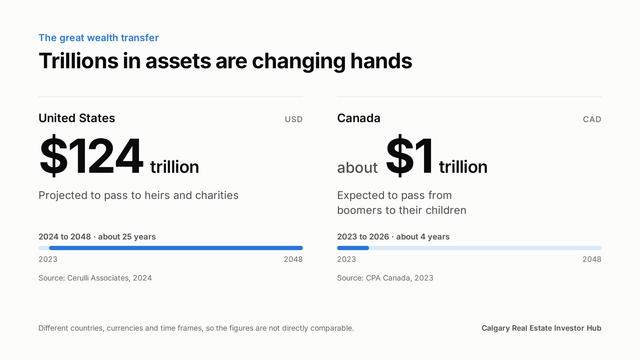
Alfonso described the current period as the greatest wealth transfer in human history, and one that gets surprisingly little media attention. As baby boomers transition out of jobs, businesses, and real estate portfolios, trillions of dollars in assets are changing hands.
He cited a figure of $124 trillion in assets set to change hands in the coming years. Closer to home, CPA Canada has estimated that roughly $1 trillion will move from Canadian baby boomers to their children between 2023 and 2026. The $124 trillion figure comes from Cerulli Associates and covers US wealth transferred through 2048. The Canadian estimate comes from CPA Canada. Note: Alfonso presented the $124 trillion figure without specifying it is US-only.
Alfonso’s view is that many heirs are not set up to own and manage the assets they inherit, often because of limited financial literacy and the tax hit that comes with an estate. As a result, he says he regularly sees family assets being sold at steep discounts. Not every heir sells, of course. But for prepared investors, estate sales and motivated sellers can create buying opportunities.
Why Alfonso Chose Multifamily Over Single-Family
Like many investors, Alfonso started with a single-family home, about 27 years ago. He sold it not long after, concluding it didn’t make sense as a business. He noticed that the wealthiest families invest in larger real estate assets rather than hundreds of individual houses, and he shifted his focus to multifamily.
The “Leaks” in a Single-Family Rental
Alfonso described a single-family rental as a property with too many leaks. With one tenant providing one income, that single rent cheque has to cover:
- Mortgage payments
- Property taxes
- Insurance
- Repairs and maintenance
- Lawn care and snow removal
- Property management
- Vacancies
- Utilities, such as water
When that one tenant moves out, 100% of the income stops while the expenses keep coming. A multifamily building spreads those costs across many rent-paying units. As Alfonso put it, more customers are better than fewer customers. That’s business 101.

He also noted that small multiplexes, like fourplexes and fiveplexes, can be hard to make work because that’s where most smaller investors compete, which pushes up the price per unit. His own focus is larger buildings, generally 20 units and up.
More Doors, Less Vacancy Risk
“The most important number in real estate is the number of doors.” – Alfonso Cuadra
Alfonso’s argument is that more units actually means less risk, not more. In one of his 60-unit buildings, six units were vacant at the time of his talk, which he described as high for them. Because vacancy was already built into the numbers, it didn’t threaten the property.
The table below uses Alfonso’s examples to show how vacancy affects income at different scales, assuming every unit rents for the same amount.
| Property | Total units | Vacant units | Units still paying rent | Share of rental income lost |
|---|---|---|---|---|
| Single-family home | 1 | 1 | 0 | 100% |
| 16-unit building | 16 | 1 | 15 | 6.25% |
| 16-unit building | 16 | 2 | 14 | 12.5% |
| 60-unit building | 60 | 6 | 54 | 10% |
Reserve Funds: Planning for Vacancy Before It Happens
Alfonso compared this to buying a condo. One of the first things a smart condo buyer checks is the reserve fund. He teaches investors to apply the same thinking to their own buildings: underwrite with a vacancy and contingency allowance, and set money aside. He says some of his buildings hold as much as $500,000 in contingency reserves.
A reserve fund is money set aside for future repairs, capital replacements, and unexpected costs. Underwriting is the process of analyzing a property’s income, expenses, and risks to decide whether, and at what price, it makes sense to buy or finance. A vacancy allowance is a percentage of potential rent deducted in your projections to account for units sitting empty.
With a healthy reserve, a building can weather a couple of years of higher vacancy. With a single-family rental, there’s usually no room in the budget to build that kind of cushion.
Economies of Scale
Alfonso compared multifamily to shopping at Costco: buying in bulk lowers your cost per unit. A single-family home is typically the most expensive real estate you’ll ever buy on a per-unit basis. With many units under one roof, maintenance, management, and operating costs are shared, which generally makes larger buildings more efficient to run.
Economies of scale are the cost advantages that come from operating at a larger size. In multifamily, fixed costs like roofing, management, and building systems are spread across more units, lowering the cost per door.
How Multifamily Financing Works Differently
A common objection Alfonso hears is “I can’t qualify” or “I don’t have the money.” His answer is that larger multifamily properties are financed very differently from houses.
Residential Lending: Your Income Is the Ceiling
For single-family homes and small rentals, lenders focus mainly on your personal income and debt-to-income ratio. Many investors eventually hit a limit on how many mortgages they can carry, which caps how big their portfolio can get.
A debt-to-income ratio compares your monthly debt payments to your gross monthly income. Canadian lenders typically measure this using the gross debt service (GDS) and total debt service (TDS) ratios.
Commercial Multifamily Lending: The Building’s Income Comes First
For larger multifamily properties, lenders look first at whether the building can carry itself, measured by its debt coverage ratio.
The debt coverage ratio (DCR), also called the debt service coverage ratio (DSCR), is a property’s net operating income divided by its annual mortgage payments. A DCR of 1.20 means the property earns 20% more than it needs to cover its debt. Net operating income (NOI) is rental and other income minus operating expenses, before mortgage payments.
Because qualification is based largely on the property’s income rather than your employment income, Alfonso sees it as a far more scalable path. He was clear that lenders still consider the borrower, but the building’s performance leads the decision.
Some added context from our side: in Canada, residential properties with five or more units generally fall under commercial lending. Commercial lenders and CMHC still review your net worth, liquidity, credit, and experience, and conventional commercial loans often require larger down payments than residential ones. It’s worth speaking with an experienced commercial mortgage broker before you start shopping.
Alfonso also shared a cautionary story about an investor who planned to overstate his income to qualify for more mortgages. Beyond the obvious problem of paying tax on income you didn’t earn, misrepresenting your income on a mortgage application is mortgage fraud. Chasing a bigger T4 to keep qualifying for more houses is not a long-term strategy.
MLI Select: What Still Works After the Rule Changes
Alfonso also discussed CMHC’s MLI Select program, which many Calgary investors have used to buy or build rental properties with a relatively small down payment.
CMHC is the Canada Mortgage and Housing Corporation, the federal Crown corporation that provides mortgage loan insurance. MLI Select is CMHC’s multi-unit mortgage loan insurance product for rental properties with five or more units. Projects earn points for affordability, energy efficiency, and accessibility commitments, unlocking benefits like higher loan-to-value ratios (up to 95%), longer amortization periods, and lower insurance premiums.
Program details and eligibility: CMHC MLI Select.
Our own guide: calgaryreihub.com/cmhc-mli-select.
Recent changes referenced by Alfonso likely include CMHC ending eligibility for bundled properties on multiple titles (February 2025) and a revised, higher premium schedule (July 2025). Verify against CMHC before publishing.
Recent changes have made the program harder to use for smaller projects like sixplexes, and Alfonso agreed those deals often don’t pencil out under the new rules. In his experience, though, larger projects still work. He says his team is building 50 to 60 units at a time at under $200,000 per door using MLI Select.
He shared a case study of a 52-unit building his team built for about $10 million using MLI Select financing. He says it is now valued at more than $15 million, and that they had no cash of their own in the deal.
The Up-Zoning Strategy
Alfonso described land development as a “staircase of profit,” with value created at each step: land entitlement, construction, lease-up, and then either takeout financing or a sale. He believes the biggest jump in value happens at the up-zoning stage. Take a single-family lot and rezone it for 50-plus units, and in his view that uplift alone can be worth a million dollars or more. That added equity can then serve as your equity contribution, such as the 5% down under MLI Select, reducing the cash you need to bring.
Up-zoning (rezoning) is changing a property’s land use designation to allow higher density. Entitlement refers to the municipal approvals needed before land can be developed. Takeout financing is the long-term mortgage that replaces a construction loan once a building is complete and leased up.
He described one investor who used this approach on two sixplex sites and went on to complete a 59-unit apartment building.
A word of caution from our side: rezoning and new construction are advanced strategies. They take time, capital, and experience, and approvals are never guaranteed. We generally recommend them for investors who already have a few years of experience and a strong team around them.

Multiple Profit Centres in One Asset
Alfonso emphasized that multifamily creates several ways to build wealth at the same time:
- Cash flow: the rental income left over after expenses and debt payments.
- Mortgage paydown: tenants’ rent pays down the loan over time, and on larger buildings the principal paid down each year is larger in dollar terms.
- Passive appreciation: increases in value driven by the market over time.
- Active (forced) appreciation: value you create by increasing income or cutting expenses, such as reducing vacancy, renovating units, or improving management.
- Refinancing: what Alfonso calls the “golden egg.” Roughly every five years, he refinances to pull out accumulated equity and put it back to work.
Forced appreciation is value an owner creates through improvements rather than waiting on the market. Because larger multifamily properties are valued largely on their net operating income, raising NOI raises the property’s value. Refinancing replaces an existing mortgage with a new one, often at a higher amount based on the property’s current value, letting the owner access equity without selling.
He also noted that larger assets make it easier to partner with other investors. Raising capital for a 60-unit building is often easier than raising it for a duplex or condo, because the opportunity is more substantial. Alfonso and his partners have also formed their own real estate investment trust.
A real estate investment trust (REIT) is an entity that owns income-producing real estate and pools money from multiple investors, who share in the income and growth. Alfonso described his as a mutual fund trust, a specific Canadian tax structure.
Buy Properties You Never Have to Sell
“The worst time to sell a property is when you have to.” – Alfonso Cuadra
Alfonso’s long-term approach is built around avoiding forced sales. Before he buys, he asks himself whether he’d be willing to keep the property for the rest of his life. If the answer is yes, he moves forward. He joked that his exit strategy is simply death.
An exit strategy is an investor’s plan for how and when they will eventually get out of an investment, such as selling, refinancing, or passing it on.
Multifamily supports that approach, he says, because income from many units, backed by reserves, helps carry a property through downturns. In his view, multifamily has historically held up better than other asset classes during recessions because the income keeps coming in.
Where Alfonso Sees the Market Heading
Alfonso believes many investors froze in 2025 while waiting for interest rates to keep falling, and that this hesitation created more opportunity in 2026. He expects rates may hold or even rise, and he anticipates a window of opportunity in fall 2026 as some homeowners refinance and redeploy their equity into real estate. He says he and his spouse plan to buy roughly $100 million of real estate this fall.
Locally, the data points to a more balanced market than a year ago. The Calgary Real Estate Board (CREB) reported Calgary inventory of 6,509 units in August 2026, roughly in line with the same month last year, while months of supply rose to about 3.9 from about 3.4 as sales slowed. CREB August 2026 market statistics.
As with any forecast, treat these as one experienced investor’s opinions, not guarantees. What matters most is whether a specific property’s numbers work for your goals.
Final Thoughts
Alfonso’s core message is that markets will always move up, down, and sideways, and investors who wait for perfect conditions often miss the opportunities in front of them. Whether or not multifamily is your next step, the principles apply at any scale: focus on cash flow, underwrite conservatively, keep reserves, and buy properties you’d be comfortable holding for the long term.
If you’re weighing whether to scale into multifamily in the Calgary area, or you’d like a second set of eyes on the numbers, we’re always happy to talk it through. You can also join us at an upcoming Calgary REI Hub meetup to learn alongside other local investors.
FAQ
Which lenders do Canadians use to finance US multifamily properties?
Alfonso explained that Canadians buying in the US are treated as foreign nationals. In his experience, more US banks are willing to lend to Canadian investors than Canadian banks are willing to lend to Canadians. His team has used Bank of America, among other lenders. He noted that lending options and rules vary by state, so the specific market you choose matters.
Which Canadian markets make the most sense right now?
Alfonso still sees opportunity in Alberta, even though the market has slowed. He noted that many people moved to Alberta for affordability and may continue on to secondary markets like Red Deer, or to Saskatchewan, particularly Saskatoon, which he likes. In Ontario, he prefers secondary and tertiary markets over Toronto, which he thinks has further to adjust, and suggested looking at Toronto early next year. He also likes Quebec, citing immigration policies aimed at growing its French-speaking population, and he owns property in Gatineau. His portfolio also includes properties in New Brunswick and Nova Scotia.
Secondary markets are mid-sized cities outside the largest metro areas. Tertiary markets are smaller cities and towns beyond those. They often offer lower prices and higher rental yields, with less liquidity.
Which US markets does Alfonso like for multifamily?
Alfonso invests based on his buy box, not on vacation destinations. He cautioned against buying a Florida condo to run as a short-term rental just because you enjoy visiting. His criteria currently point him toward Ohio, particularly Cleveland and Columbus, as well as Tennessee, the Carolinas, and secondary markets in Texas.
A buy box is an investor’s specific set of criteria for acceptable deals, such as property type, size, location, price range, and minimum returns.
Why does Alfonso steer away from California?
He pointed to tenant-friendly policies that make it harder for landlords to operate, and said he prefers landlord-friendly markets. As an example of how much rules differ, he mentioned that in Arkansas, tenants who fail to pay rent and refuse to leave after notice can face criminal charges. Alfonso described nonpayment of rent in Arkansas as “a felony.” Under Arkansas’s failure-to-vacate statute, it is a misdemeanor, and it applies only when a tenant behind on rent refuses to leave after a 10-day written notice. Legal Aid of Arkansas: Failure to Vacate.
Landlord-friendly markets have laws that make it relatively straightforward to collect rent, enforce leases, and resolve evictions. Tenant-friendly markets have stronger protections for renters, such as rent control and longer eviction timelines.