

By: Calgary Real Estate Investor Hub
Key Takeaways
- 90% of the work for a successful tenancy happens upfront during tenant screening — invest time there and the rest is much smoother.
- In a soft rental market, you need to reduce friction at every step: respond fast to inquiries, book viewings in bunches, and advertise on multiple platforms with professional photos.
- Pre-screen questions serve a dual purpose: they filter out poor fits and double as behavioural tests to see how a prospective tenant communicates and follows instructions.
- A tenant’s credit score alone doesn’t tell the whole story — review the full payment history timeline to understand whether issues stem from habits or a one-time life event.
- Verify all application documents from trusted sources, not from the tenant directly. AI is making fraudulent applications increasingly difficult to detect on the surface.
- In Alberta, fixed-term leases give landlords significantly more options and protection than month-to-month agreements — use them consistently.
- Documentation is everything. Written notices, move-in/move-out inspections, a clear ledger, and email trails are what wins or loses an RTDRS case.
- The RTDRS handles ~90% of landlord-tenant disputes in Alberta. It’s faster and cheaper than court, but it has strict service and documentation rules.
- A security deposit cannot exceed one month’s total rent (including all fees) and must be refunded in proportion to any rent reductions.
- Fees like late penalties may not be enforceable through RTDRS, but they can still function as useful deterrents when written into a lease.
Rental income is the engine that powers most real estate investment strategies. But that engine only runs well when you have the right tenants in your properties. We’ve seen it play out both ways — landlords who vet carefully and rarely deal with problems, and landlords who skip steps and pay for it.
At a recent Calgary REI Hub meetup, we had two guest speakers who between them covered the full lifecycle of landlord protection: how to find and screen great tenants before they move in, and what to do legally if things go sideways after. McKenzie Wilson, Director of Customer Engagement at Single Key and founder of the Alberta Landlord Community Facebook group, walked us through a practical tenant screening framework. Kayla Wilson, CEO of Everway Legal Support, followed with a breakdown of the RTDRS process and how to defend yourself if a tenant takes you to court.
Here’s what we learned.
The Landlord Mindset: Where Most of the Work Actually Happens
McKenzie framed the whole screening challenge well from the start. In a short window of time, with a complete stranger, you have to build enough trust to hand over control of one of your most valuable assets. That’s genuinely hard — and most of the effort that determines whether a tenancy goes well happens before the tenant ever gets a key.
“You put 90% of your effort to find that great tenant. The rest of the tenancy is… on auto cruise. They’re easy to work with. You’ve got the right person.” — McKenzie Wilson
Two things make a good tenant: a solid financial profile and a good relational fit. The financial side is black and white — income verification, credit check, debt-to-income ratio. The relational side is more nuanced and personal. How a tenant responds throughout the screening process — whether they communicate clearly, follow through on small asks, show up when they say they will — tells you a lot about what kind of tenant they’ll be.
Screening in a Soft Market: What Has to Change
Two years ago in Calgary, landlords were fielding 50–80 inquiries in the first 24–48 hours after posting a listing. That is no longer the reality. Vacancy rates have risen, and tenants now have options. That doesn’t mean good tenants aren’t out there — it means you have to work a little harder to attract them and move faster when you find them.
McKenzie flagged a few things worth adjusting in a slower market:
Respond to Inquiries Immediately
High-quality tenants move quickly. If you’re slow to respond, they’re already somewhere else. Keep a set of pre-screen questions ready on your phone — either as a digital note or as a saved text — so you can reply to any inquiry promptly. These questions don’t need to be exhaustive. They just need to confirm enough to know whether it’s worth everyone’s time to meet in person. Basic fit questions: How many people will be living in the unit? What’s your target move-in date? What’s your current living situation?
Book Viewings in “Tea Time” Blocks
Schedule viewings in tight windows — 10 minutes apart. This creates visible competition. When a prospective tenant finishes their viewing and walks out to see the next group waiting to come in, it removes any ambiguity about interest in the property. You don’t have to tell them other people are looking — they can see it. Even in a soft market, that creates urgency and gets applications in faster.
In a hot market, you’d filter your viewing list strictly. In a soft market, widen the net a bit. Invite people who wouldn’t normally make your shortlist, just to populate those viewing slots. The goal is to have visible competition even when the inquiry volume isn’t what it used to be.
Advertise on Multiple Platforms with Strong Photos
Rent Faster has historically been Calgary’s dominant platform, but the better approach is to test multiple listing sites. Run several Google searches using different terms — “two-bedroom condo for rent Calgary,” “two-bedroom apartment for rent Calgary” — and note which sites consistently appear at the top of results. Those are the platforms getting the most traffic. List there.
Professional photos are worth the cost. For $100–150, you get images that actually pull people into the listing. A video walkthrough or virtual tour does even more — it lets tenants mentally walk through the space before calling, which means the people who do reach out are already a better fit for what you’re offering. Fewer tire kickers, more qualified inquiries.

Pre-Screen Questions and the Behavioural Test
McKenzie shared one pre-screen tactic that stood out as particularly clever. After going through his standard questions on the phone with a prospective tenant, he ends with something like this:
“Before I confirm this appointment as finalized, I need you to send me a text about an hour before just to confirm. If I don’t get that text, I consider the appointment cancelled and I won’t be there.”
This does two things. First, it filters out no-shows — McKenzie said he’s only been called twice in seven years of using this approach. Second, it’s a simple behavioural test. Can this person follow a basic instruction, manage their own calendar, and communicate proactively? If yes, that’s a good indicator they’ll be easy to work with when something needs attention at the property.
Time is the real constraint for most investors. Most of you have full-time jobs and a personal life. Anything that helps you protect your time and run this more efficiently is worth building into your system.
Reading a Credit Report: What Actually Matters
McKenzie walked through a sample Single Key report. Here’s what you’re looking at and how to interpret it:
The Credit Score
A credit score is a snapshot in time. It doesn’t necessarily reflect someone’s ongoing financial habits. A score in the 570–650 range isn’t an automatic disqualifier — especially if that person has been through a divorce, a job loss, or another significant life event that temporarily damaged their credit. The key is to dig deeper before making a decision.
The Trade Line Payment History
A trade line is any credit product — credit card, car loan, cell phone contract, line of credit — that has been reported to Equifax or TransUnion. Each product appears as a separate entry on the credit report. Most lenders and screening tools pull this data to build a full picture of credit behaviour.
Single Key’s trade line payment overview shows a month-by-month history of whether payments were made on time, and how late they were (30, 60, 90, 120+ days). This is where McKenzie’s advice gets practical:
- If you see a cluster of late payments during one specific time period and the tenant mentions they were laid off or went through a divorce around that time, the story lines up. That person likely has good financial habits and just had a rough patch.
- If you see a checkerboard pattern — no rhyme or reason, scattered late payments across years — that’s a red flag. That’s a pattern, not an event.
The trade line history is also colour-coded: green means current, yellow means some late payments, red typically means the account has gone to collections.
Address Cross-Reference
Single Key automatically cross-references the billing addresses found in the applicant’s Equifax or TransUnion report against the rental history they provided on the application. If those addresses match, you have a higher degree of confidence that the rental history is accurate. It’s not foolproof — the data in bureau reports isn’t always complete — but a strong cross-reference match is a meaningful data point.
ID Verification
Single Key now includes a current selfie alongside the government-issued ID photo. This addresses a real problem McKenzie pointed out: a passport can be 9 years old in a 10-year passport, and the person you met at the viewing might look unrecognizably different. Having a current selfie alongside the ID gives you a meaningful way to confirm you’re dealing with the same person.
Eviction Records
Single Key also scans Open Room (a crowdsourced eviction database with over 40,000 records, primarily Ontario-based) and CanLII (which indexes tribunal decisions including Alberta’s RTDRS). A clean result doesn’t guarantee no history — not all Alberta eviction records are available online yet — but flagged records are meaningful. If you want to do a direct search through RTDRS, you can submit a request through Service Alberta, though turnaround is typically 3–6 business days.
CanLII is Canada’s free legal database, maintained by the Federation of Law Societies. It includes past tribunal decisions from provincial bodies like Alberta’s RTDRS.
Verifying Application Documents: Don’t Take Anything at Face Value
McKenzie’s firm rule: collect information from applicants, but verify it from trusted sources. Never accept screenshots of credit scores from Credit Karma or Borrowell. Those can be edited. Get the report pulled directly from Equifax or TransUnion through a screening provider.
The same applies to pay stubs and bank statements. Single Key only accepts PDFs for these documents, and it scans the metadata in those files — the underlying file information that shows what software created or modified the document. If a bank statement shows “Canva” or “iLovePDF” as the editing software, that’s a red flag. Legitimate bank statements should show the bank’s own software or a recognized financial services PDF provider as the creator.
McKenzie also noted that this is only going to become more important as AI tools improve. Fraudulent documents are going to look increasingly polished on the surface. Diligent verification is the only defence.
“Your job is to collect as much relevant information, but verify it from trusted sources.” — McKenzie Wilson
One additional note McKenzie made: every adult over 18 living in the unit should be listed as a tenant on the lease and should undergo a credit check — not just one primary tenant with others listed as occupants. The reason is straightforward: if things go sideways, you want multiple people you can pursue legally. Two income sources and two people you can go after is always better than one.
Understanding the RTDRS: Alberta’s Landlord-Tenant Tribunal
Kayla Wilson runs Everway Legal Support, a company that primarily represents landlords through the Residential Tenancy Dispute Resolution Service (RTDRS) and provides process serving.
The RTDRS (Residential Tenancy Dispute Resolution Service) is Alberta’s tribunal body for landlord-tenant disputes. It handles claims up to $100,000, costs $75 to file, and is significantly faster than the Court of King’s Bench. Decisions carry legal weight and are filed with the Court of King’s Bench. Anything over $100,000 in claims must go to King’s Bench directly.
A few key numbers from Kayla: RTDRS handled just over 14,000 cases last year. This year it’s at 16,000, and the volume is growing. Cases involving landlords being sued by their tenants have quadrupled at Everway alone. This is no longer a niche process — it’s something any active landlord in Alberta should understand.
Current wait times are around 5 weeks for a hearing date. That’s down from 8 weeks over the summer, and the RTDRS recently added 8 new hearing officers with the goal of bringing it back to the 2–3 week range it used to average.
Alberta RTDRS — Government of Alberta — official filing information, forms, and process guides.
Common Reasons Tenants File Against Landlords
- Security deposit not returned (or improper deductions)
- Deficiencies in the unit (repairs not done, habitability issues)
- Rent abatement claims (tenant lost full use or enjoyment of the property)
Common Reasons Landlords File Against Tenants
- Non-payment of rent (21A breach under the RTA)
- Overholding (fixed-term ended, tenant refuses to leave)
- Property damage
Kayla’s success rate for landlords who come with solid documentation is 70%. That number drops significantly when documentation is incomplete. There’s a pattern here.
If You’re Served: What to Do First
Getting served with an RTDRS claim is stressful, but Kayla made the point that the number on the claim — sometimes $50,000 or more — often doesn’t reflect what will actually be awarded. Don’t panic at the number. Look at the evidence and assess the actual merit.
The first things to check:
- Was service valid? You must receive the claim at least three clear business days before the hearing. If you didn’t, you can request an adjournment.
- Did you receive the full packet? The claim should include the notice of hearing, the application, and all evidence. If any of those are missing, that’s grounds for adjournment.
- Set up your RTDRS profile. It provides guidance on next steps and lets you see whether you’re headed to a preliminary or full hearing. Preliminary means a new date will be set — more time to prepare.
You can upload your evidence up to 24 hours before the hearing, but you must also serve that evidence to the tenant in the same timeframe.
Documentation: The Difference Between Winning and Losing
Kayla said it plainly: documentation, documentation, documentation. The landlords who lose RTDRS cases are almost always the ones who didn’t keep adequate records. Here’s the foundation you need:
- A signed written lease. Verbal leases are technically accepted in Alberta but Kayla strongly advises against them. When there’s no written record, a hearing becomes a credibility contest.
- A rent ledger. Track every payment, every late payment, every partial payment.
- Move-in and move-out inspection reports. Without a move-in inspection, you cannot make any claim on the security deposit. Period. Video inspections are accepted, but combine them with a signed written condition report. Use a reference object (a business card, a coin) in photos of damage to give scale.
- Written notices, properly posted. Notices must be posted to the tenant’s primary entrance — not texted, not emailed alone. Post it, photograph it at the door with the address visible, and keep that photo. Follow up with email or text if you like, but the physical posting is what counts.
- Repair invoices. For damage claims, you must have completed the repairs before filing. Estimates aren’t accepted.
Alberta Residential Tenancies Act (RTA) — the governing legislation for all residential landlord-tenant relationships in the province.
Kayla also noted that if you need notice templates, the Calgary Residential Rental Association (CRRA) and the Alberta Residential Landlord Association (ARLA) both offer properly formatted forms reviewed by legal counsel. Use those rather than writing your own.
Lease Structure: Fixed-Term vs. Month-to-Month
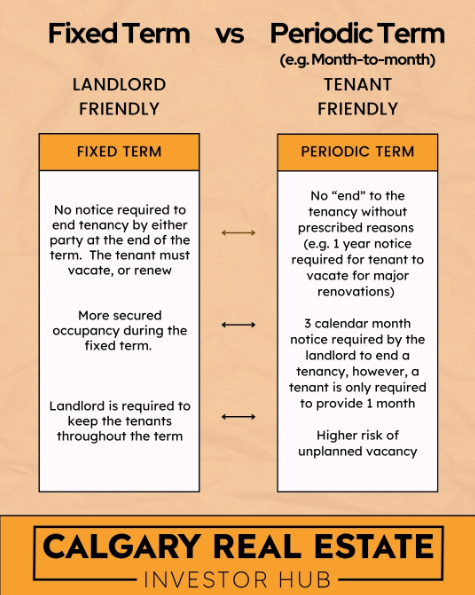
Kayla and McKenzie were in full agreement here: always use a fixed-term lease. The advantages are significant.
In Alberta, when a fixed-term lease ends, you are not required to renew it for any reason. You don’t need to provide a reason. You simply don’t renew, and the tenancy ends. With a month-to-month tenancy, you can only terminate under specific prescribed reasons defined in the RTA, and you must provide three clear months’ notice.
This has practical implications:
- Even if a tenant wants to stay “just one more month” at the end of a lease, have them sign a one-month fixed-term lease. If they don’t, they’ve rolled into month-to-month, and now you’re in a more complicated position if you ever want them out.
- You can sign a fixed-term lease for any duration — 3 months, 15 months, 18 months. If you want the lease end date to fall in summer (easier to re-rent), sign accordingly.
- Rent cannot increase during the term of a fixed-term lease. Any rent changes must happen at renewal. You cannot write a scheduled increase into the middle of a lease term. One creative alternative: rent abatement. Set the full lease rate and offer a reduced amount for the first several months as a temporary abatement. This is different from a scheduled increase and can work if structured from day one.
Security Deposit Rules You Need to Know
A few deposit rules that often catch landlords off guard:
- The security deposit cannot exceed one month’s total rent. Total rent includes all fees — base rent, pet fee, parking, utilities allowance, etc. The deposit cap applies to the combined total.
- If you reduce the rent at any point, you must refund the corresponding portion of the deposit. You cannot hold the higher deposit amount.
- If the rent increases on a new fixed-term renewal, you cannot automatically top up the deposit. You would need to return the old deposit and collect a new one at the higher amount — which is rarely worth the hassle unless the difference is significant.
- When making deductions from a deposit for damages, you must apply the depreciation chart. A carpet that’s 8 years old has depreciated. A wall that should have been repainted at 6 years cannot be charged to the tenant. Know the chart before you make any claims.
Alberta Security Deposits — Government of Alberta — details rules for collecting, holding, and returning damage deposits, including the depreciation framework.
Hearing Prep: If It Goes to RTDRS
Hearings are conducted by phone. You can literally take a hearing from anywhere, as long as you have a good signal. Here’s Kayla’s prep advice:
- Find a quiet spot. Have scripted notes. Label your pages so you can reference evidence quickly (“See evidence page C1 — photo of the damaged door frame”).
- Stick to facts. The tenant may say things that feel deeply unfair. Don’t interrupt. Don’t get emotional. A hearing officer wants evidence and clear chronology, not a heated back-and-forth.
- You can cross-examine the tenant — do it respectfully.
- If the hearing officer disconnects you for over-talking, the hearing can proceed without you. Only speak when it’s your turn.
Outcomes will either be a conditional order (tenant must pay by a certain date and stay current or face termination) or an unconditional order (termination date set, it’s done). To enforce either, you’ll need a bailiff, which requires a court order — another reason the RTDRS paper trail matters.
What Everway Legal Support Charges (as of this presentation)
If you want professional representation through the RTDRS process, Kayla’s firm charges $650 all-in. That covers the application, serving the tenant, hearing representation, filing with the Court of King’s Bench, and the affidavit of service. Process serving through their recommended bailiff (Servet Bailiff) runs an additional $519. Volume/corporate rates are available for landlords with multiple doors.
You can also claim up to $250 of your representation fees back from the tenant if you win, which the RTDRS rolls into the order.
FAQ
Q: We’re purchasing a property with tenants who are behind on rent and the current owner may be taking them to court. Should we wait for that to resolve before closing, or can we just buy the property and deal with it?
A: You have a few options. In a buyer’s market, you have some leverage to make the seller deal with the tenant situation as a condition of the sale. If you can negotiate that into the offer — requiring the seller to resolve the tenancy before closing, with compensation to you if they don’t — that shifts the burden. You also have the option to take possession and pursue the tenant yourself through the RTDRS under a failure-to-pay-rent application (21A breach). Both can technically run simultaneously. The key is to have it addressed in the purchase contract rather than inheriting the problem without any protection. Talk to a lawyer or contact RTDRS directly before finalizing your approach.
Q: Should a bad tenant situation scare me away from an otherwise good property deal?
A: Not necessarily. There are systems for dealing with difficult tenants, and a problem tenant is often easier to address than finding a comparable property. Run your numbers, assess the area, and if the property works, go forward — but make sure the tenant situation is addressed properly in your purchase conditions.
Q: How long is a Single Key tenant screening report valid? What if a tenant brings their own?
A: Single Key reports are valid for 35 days from the date the tenant activates it. In practice, McKenzie wants to see reports no older than about a month. Anything older raises questions. If a tenant brings their own report, that’s useful context but shouldn’t replace an independently pulled credit check. You want the data coming directly from Equifax or TransUnion, not from a document the applicant controls or could have altered.
Q: Can a tenant send me a screenshot of their credit score from Credit Karma or a banking app instead of doing a proper credit check?
A: No. Screenshots from consumer credit apps can be edited and don’t carry the same reliability as a report pulled directly from Equifax or TransUnion by a screening provider. You should always request the full report through a service like Single Key.
Q: What if a senior family member — like a parent — is living with the tenants but not the primary renter?
A: This depends on the financial strength of the primary applicants. If they’re financially solid, listing the senior as an occupant rather than a co-tenant is likely fine. If the primary applicants are borderline, it’s worth listing everyone over 18 as a tenant so you have more recourse if needed.
Q: Can I use video for my move-in inspection instead of a written report?
A: Yes, video is accepted. That said, it’s recommended to combine video with a written condition report that the tenant signs. Use a reference object in photos to provide scale for any existing damage. Keep the commentary professional — remember that anything you record could be submitted as evidence. After the video walkthrough, transcribing the key points and having the tenant sign off is a strong approach.
Q: I have a tenant who is behind on rent. They can technically stay in the unit until I get a court order. What do I do?
A: Correct — you cannot physically remove a tenant without a court order, which requires going through the RTDRS or Court of King’s Bench first. File as soon as possible. The 14-day notice you issue for non-payment is documentation for your case, not an automatic removal mechanism. Once you have a RTDRS order, you can hire a bailiff to execute it. Sooner is always better — don’t let months of unpaid rent accumulate before taking action.
Q: Is tenant insurance mandatory, and what happens if they cancel it after moving in?
A: Tenant insurance is not mandatory in Alberta and tenants can cancel it at any time. The landlord’s insurance is the primary protection for the property. If there is damage and the tenant was uninsured, you can still pursue them for damages through RTDRS — you just need completed repairs and documentation. You can also go after them directly for your deductible. Some insurance providers (Walnut and Westland were mentioned) will notify landlords when tenant insurance is cancelled, which is worth looking into.
Q: Can you charge a pet fee?
A: Yes. You can charge a monthly pet fee or a one-time non-refundable pet fee. What you cannot charge is a separate pet damage deposit on top of the standard security deposit. All fees — rent, pet fee, parking, utilities — make up the total monthly rent amount, and the security deposit cannot exceed that total amount. The fees need to be clearly itemized in the lease.
Q: Can I include late fees or NSF fees in my lease?
A: You can include them, and they can serve as a useful deterrent. However, the RTDRS will generally not grant those amounts in a claim — they’re considered additional financial burdens on the tenant. If a tenant voluntarily pays the late fee, you can accept it. But don’t expect to recover those amounts through the tribunal.
Q: What’s the difference between a rent increase and a lease renewal? Do I have to post a rent increase notice if we’re signing a new fixed-term lease?
A: These are two different things. A rent increase on a month-to-month tenancy requires formal written notice posted to the tenant’s door (registered mail is also acceptable). A lease renewal — where you’re signing a new fixed-term lease — is treated as a new agreement, not a rent increase notice situation. You can set whatever rent you agree to in the new lease without going through the formal increase process. That said, if you want to give tenants advance notice of the upcoming renewal terms (which is good practice and saves you last-minute scrambling), giving one to two months’ notice before the lease end is recommended.
Q: Can an altercation between two tenants in a multi-family property result in a landlord being held financially responsible?
A: In most cases, no. If one tenant assaults another, that’s a criminal matter between those individuals. However, if you were aware of a maintenance issue that contributed to the incident — for example, a broken door lock that allowed unauthorized entry — you may bear some responsibility for that underlying deficiency. Any medical damages would go through the Court of King’s Bench, not RTDRS. Document any tenant complaints about unit conditions and address them promptly.
